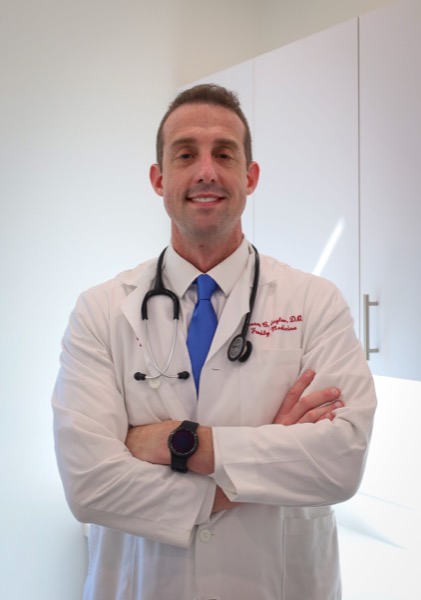
The Valrico problem isn't finding a clinic. It's finding primary care in Valrico that survives contact with a working calendar. If your weekday is already full before it starts, a doctor's office that only exists between nine and five in a fixed building is an appointment you will eventually stop making. Ascend Mind and Body built around that reality: Dr. Jason Saylor, DO, board-certified family physician with 17 years of experience, in person at our Tampa-Carrollwood office at 3971 Moran Road, Suite 101, and on video for the established-patient visits that never needed a waiting room in the first place.
Adult vaccines: the schedule nobody handed you
Childhood immunization comes with a card, a schedule, and a school district checking up on it. Adult immunization comes with none of that, which is why most adults are behind on something and have no idea which thing. It is one of the few areas of preventive medicine where the intervention is cheap, quick, and genuinely underused, and it is worth knowing what belongs on your list.
Tetanus is the one people half-remember. A booster every ten years, with the caveat that at least one of those should be the version that also covers pertussis, and that anyone around a newborn should be current on it specifically to protect the infant rather than themselves. Influenza is annual, and the usual objection, that it does not always match well, misses the point: partial protection against a serious illness is still worth an afternoon of a sore arm.
Shingles is the one most often missed and most often regretted. It is recommended from age 50, it is a two-dose series, and it substantially reduces both the rash and the lasting nerve pain that can follow it, which is the part that ruins people's years. Anyone who has had chickenpox carries the virus, which is nearly everyone over a certain age. Pneumococcal vaccination has its own age threshold and additional criteria for adults with lung disease, diabetes, or a compromised immune system.
Then there are the ones driven by history rather than age. Hepatitis B for adults with diabetes, liver disease, or specific exposures. Hepatitis A depending on risk and travel. HPV vaccination, which is now recommended considerably later into adulthood than most people assume and is worth asking about rather than writing off. And COVID vaccination on whatever the current schedule is, which changes often enough that it belongs in a conversation rather than in a fixed paragraph on a website.
The practical problem is not disagreement about any of this. It is that nobody is tracking it. Records are scattered across a childhood pediatrician, a college health service, a pharmacy, and an employer clinic, and the state immunization registry catches some of it but not all. Bringing whatever documentation you have to a physical, even a partial or messy record, lets us build one list and fill the gaps, which usually takes a single visit to sort out and then stays sorted.
Ascend has no Valrico office. In-person visits happen at our Tampa-Carrollwood office, 3971 Moran Road, Suite 101, or at Wesley Chapel, 27724 Cashford Circle, Suite 102. Everything that doesn't require a physician's hands can move to a screen, which is what makes keeping one doctor for years realistic on a working schedule.
The same doctor in the exam room and on the screen
The telehealth industry's dirty secret is that video medicine is usually anonymous medicine: a different clinician every call, reading your file for the first time on their second monitor. That's not what this is. Every visit in this practice, in person or virtual, is with the same physician who did your intake.
Dr. Jason Saylor, DO earned his osteopathic medical degree at Philadelphia College of Osteopathic Medicine and has spent 17 years practicing across urgent care and private settings. He's board-certified in family medicine and sees patients in person at the Tampa-Carrollwood and Wesley Chapel offices. Osteopathic physicians train exactly as MDs do, then add focused work on the musculoskeletal system and an orientation toward the whole patient rather than the isolated complaint, and they prescribe, image, and refer identically. In the room that shows up as attention to the connected things: sleep, work stress, digestion, weight, family history, the threads a rushed visit never has time to pull. His panel stays intentionally small. That's what makes the one-doctor promise mechanically possible: when he takes your video call in November, he remembers the conversation from your physical in March, because both were his.
Continuity also has a safety dimension that rarely makes the brochure. Interactions get caught by the prescriber who wrote both prescriptions. A subtle change in weight or mood reads differently to someone holding last year's version of you in memory. And when you call about something ambiguous, the advice comes from context rather than a script.
He also doesn't work in isolation. If depression, anxiety, or stress is woven into the medical picture, psychiatry with Anna Stouffer, PMHNP-BC and the talk therapy team are available to Valrico patients by Florida telehealth, inside the same practice.
What has to happen in person, and what honestly doesn't
Florida telehealth here follows one clean rule: video is for maintenance, hands are for examination. Established patients handle medication refills, stable chronic-disease follow-ups, lab reviews, and many simple acute issues over video. Annual physicals, new-patient evaluations, and anything that calls for auscultation, palpation, or in-office testing are done in person at Tampa-Carrollwood or Wesley Chapel.
The in-person list is non-negotiable because examination is non-negotiable. Blood pressure technique, listening to heart and lungs, palpating the abdomen that's been hurting, the in-office tests that turn a hunch into an answer: none of it survives translation to a webcam, and we won't pretend it does. Telehealth earns its keep precisely because it's honest about its limits.
Where you fall on that line isn't guesswork. Dr. Saylor sets the cadence and the modality with you at the first appointment, based on what's actually being treated, and revisits it when your situation changes. A stable hypothyroid patient in FishHawk might touch the office once a year and handle the rest from a laptop after the school run. Someone mid-workup will be in person more often until things settle. Most established patients converge on one in-person visit annually plus video check-ins between, which is roughly the ratio a working life can sustain indefinitely. All a video visit demands is a camera-equipped device and a Florida location at appointment time; most people fold them into the corners of a workday, which is exactly the point.
Labs fit around your schedule too. Quest Diagnostics and Labcorp both operate collection sites around Valrico, Brandon, and FishHawk. Orders go to whichever site you name, and results generally post to your patient portal within one to three business days.
The first appointment sets the rhythm for everything after
Whatever mode your ongoing care takes, it starts in person and it starts thorough. Budget 45 to 60 minutes, and expect to talk as much as you're examined; the history is where family medicine earns its keep, and an hour spent mapping it properly beats years of treating fragments. Intake forms are done online ahead of time; you bring your medication list, over-the-counter items and supplements included, any prior records worth reviewing, and your insurance card so benefits get verified before the visit. Dr. Saylor takes the history properly, examines you, orders whatever baseline labs you're missing, and then builds the plan with you: which conditions get active management, which screenings are due, which referrals make sense, and crucially, which parts of your follow-up can live on video. A written summary posts to your portal after.
If you're transferring from another practice, start the records release early; offices vary wildly in how fast they respond, and having the old chart in hand makes the first hour dramatically more useful. Bring the actual pill bottles too, supplements included. What's printed on a label routinely disagrees with what anyone remembers.
From there the calendar mostly runs itself. Chronic conditions get rechecked every three to six months once stable. The annual physical anchors the year. When something acute hits between, respiratory infections, GI trouble, skin issues, injuries, established patients can usually be seen the same week; new patients typically get a first appointment within one to two weeks. Calling (813) 670-3331 early in the morning is the move for same-day questions.
One boundary worth stating: an acute visit here is also a checkpoint. If the third sinus infection of the year, or a blood pressure reading taken while you were in for something else, hints at a bigger pattern, it gets flagged and worked up rather than waved through. That's the difference between treating visits and treating a person.
Chronic conditions, watched all year instead of once a crisis
The busy-schedule failure mode in chronic disease is simple: the condition is quiet, the schedule is loud, and monitoring loses. Blood pressure creeps for eighteen unmeasured months. A diabetic goes a year past the A1c that should have changed the plan. Making follow-up cheap in time is not a convenience feature; it's the treatment plan's survival mechanism. Hypertension is practically the case study: it announces nothing, responds well to steady management, and punishes neglect years later.
Within that structure, the clinical work is full-scope family medicine. Hypertension: diagnosis, lifestyle integration, medication titration, ongoing monitoring. High cholesterol: lipid panels, family-history risk assessment, and a frank statin discussion. Type 2 diabetes: A1c management and medication selection spanning metformin and, where appropriate, the GLP-1 and SGLT2 classes, with dietary counseling and ophthalmology or podiatry referrals as the condition requires. Hypothyroidism: TSH monitoring, levothyroxine titration, evaluation for Hashimoto's when warranted. Chronic pain: non-opioid approaches first, physical therapy referrals, disciplined medication management. Prevention runs underneath it all, annual physicals, age-appropriate cancer screening, vaccinations, baseline labs, and cardiovascular risk assessment, so the quiet years stay quiet.
The screening calendar rides the same rails. Cancer screening gets scheduled when your age calls for it, vaccinations stay current, baseline labs refresh on cadence, and cardiovascular risk gets recalculated as the inputs change rather than once a decade. The chart carries that calendar so you don't have to.
When specialists enter the picture, coordination is part of the service. With your written consent, records move between us and your cardiologist or endocrinologist by secure portal or fax, and Dr. Saylor keeps the master thread.
Coverage, benefits checks, and paying out of pocket
Insurance first: for primary care visits, Dr. Saylor is in-network with Aetna, ChampVA, and UnitedHealthcare. Plans differ even within a carrier, and the accepted list gets updated over time, so the dependable step is a phone call. Dial (813) 670-3331 with your card in hand and the team verifies your benefits before you're ever in a room. And a commitment we hold to: no out-of-network billing for primary care without a clear conversation about cost with you beforehand.
Self-pay, including the high-deductible version of self-pay, is quoted rather than posted. What a visit costs depends on whether it's initial or established, in person or video, and what labs or procedures happen that day, so the website carries no flat-rate sheet. The billing team confirms the exact figure when you call, and asking about cash-pay options is worth the extra minute.
Two scheduling notes for people with full weekdays, since this whole page is for them. The slots on either side of the workday go first, so book the annual physical further out than feels natural. And when a video follow-up is all you need, take the video follow-up; booking an in-person slot out of habit spends the one resource this model was built to save you.
Booking works by phone at (813) 670-3331 or online. Pick the office that fits your week, block out the long first visit once, and let the rest of the year bend around your schedule instead of the other way. New patients typically get that first appointment within one to two weeks, and if the choice between Carrollwood and Wesley Chapel isn't obvious from your address, describing your usual weekday route to the scheduler is enough to settle it.
That's the whole pitch, honestly: a board-certified family physician seventeen years in, a first hour that earns the years after it, and a practice arranged so that keeping a doctor doesn't have to compete with keeping a job.
Also see our nearby primary care options
Looking for in-person care, or comparing across Tampa Bay clinics?
- Primary care in Tampa: in-person at our Carrollwood office
- Primary care in Wesley Chapel: in-person at our Pasco County hub
- Lakeland location: our Polk County office
- Primary care in Brandon: telehealth, neighboring east Hillsborough
- Primary care in Riverview: telehealth, south of Valrico
For mental health alongside primary care, see psychiatry in Valrico (Anna Stouffer, PMHNP-BC, via Florida telehealth) or talk therapy in Valrico.
FAQs about primary care in Valrico
Why doesn't Ascend have a Valrico primary care office?
We focus on three physical locations (Wesley Chapel, Tampa-Carrollwood, and Lakeland). Ascend has no Valrico office. Tampa-Carrollwood, at 3971 Moran Road, Suite 101, Tampa, FL 33618, is the closest in-person primary care clinic for Valrico residents. Wesley Chapel, at 27724 Cashford Circle, Suite 102, Wesley Chapel, FL 33544, is the other option.
Can primary care be done via telehealth?
Some primary care can - medication refills, stable-condition follow-ups, lab review, simple acute issues. Annual physicals and any visit requiring a hands-on exam need to be in person. Dr. Saylor sets the cadence and modality with you at your first appointment based on what you're being treated for.
How quickly can I get an appointment?
New patient appointments are typically available within 1-2 weeks. Established patients with acute issues can usually be seen the same week. Call (813) 670-3331 in the morning to ask about same-day availability.
Where do I get my labs drawn?
Quest Diagnostics and Labcorp both operate collection sites across Valrico, Brandon, and FishHawk. We send the orders to whichever location is most convenient. Results post to your patient portal within 1-3 business days for most panels.
What is the difference between a DO and an MD?
Doctors of Osteopathic Medicine (DOs) complete the same medical training as MDs plus additional training in the musculoskeletal system and a whole-person approach. DOs prescribe medication, order imaging, and refer to specialists exactly like MDs. The philosophical difference is integrative - treating the whole patient, not just the disease.
Will Dr. Saylor coordinate with my specialists?
Yes. With your written consent, we exchange records with your specialists by secure fax or portal. Care coordination is a core part of primary care, especially for patients with multiple chronic conditions or active treatment with cardiology, endocrinology, or other subspecialties.