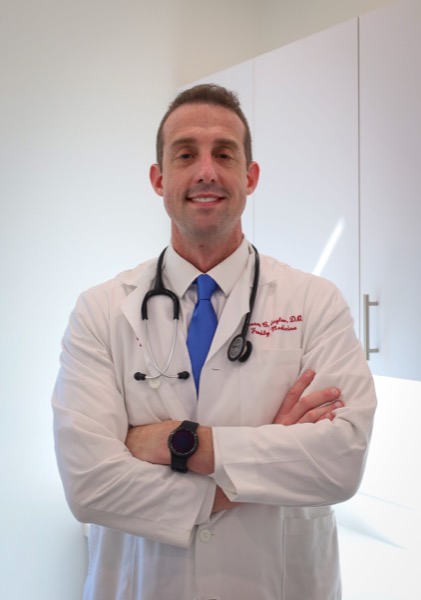
Finding a primary care doctor in Brandon shouldn't be harder than finding a mattress store, and yet here we are. Count what a Brandon shopping run passes: retail at every light, a walk-in clinic every mile or so, and remarkably few family physicians with room on their panels. Ascend Mind and Body's answer is Dr. Jason Saylor, DO, a board-certified osteopathic family medicine physician with 17 years of experience, seeing Brandon patients in person at our Tampa-Carrollwood office at 3971 Moran Road, Suite 101, with telehealth handling much of what comes after. Call (813) 670-3331 or book online to start.
The urgent care loop, and why Brandon makes it so easy to fall into
Eastern Hillsborough grew up around its shopping districts, and healthcare followed the same retail logic: convenient, visible from the road, open evenings, no relationship required. When your throat hurts on a Tuesday night, the clinic near the mall will see you, and honestly, for a Tuesday night sore throat, that's fine. The trap closes slowly. The strep visit becomes the pattern. Blood pressure gets taken at each stop and never followed anywhere. Three different prescribers each see one-third of your medication list. Five years pass and you realize nobody, anywhere, is responsible for your health as a whole. You have receipts instead of a chart.
None of that is the fault of the clinicians working those shifts. Episodic care is built to answer one question, "what's wrong today," and it answers it reasonably well. The questions it structurally cannot answer are the ones that determine how your fifties and sixties go: is that blood pressure a trend, did the cholesterol respond to the statin, when was the last A1c, who's watching the thyroid dose. Those need one physician, one record, and scheduled returns. That's the entire argument for primary care, and Brandon's landscape makes it worth stating out loud.
What one continuous chart changes
Continuity sounds abstract until you watch it work. A patient who's been with the same physician for three years walks in with fatigue, and the doctor isn't starting from zero; the chart already holds two years of labs, a medication history, a weight trend, and a note about a stressful job change. The workup gets targeted instead of scattershot. Small drifts get caught while they're still small. Medication changes come with a scheduled recheck instead of a shrug and a hope.
Medication reconciliation is the least glamorous example and maybe the most important one. After a few years in the episodic system, many adults carry prescriptions from three or four sources: the walk-in that treated the sinus infection, the ER from that one bad night, a specialist, an old PCP. Nobody has looked at the full list side by side, checked it for interactions, or asked whether half of it is still doing anything. A single physician owning a single chart does that routinely, at every visit, without it ever being a billable event or a dramatic save. It's just what happens when someone is actually responsible.
That's the model here: one physician, one chart, one ongoing relationship, deliberately kept at a smaller panel than the region's norm so appointments don't shrink to twelve minutes. Established patients who wake up sick can usually be seen the same week rather than being bounced back to the walk-in circuit. And because Ascend also runs psychiatry and talk therapy, the things a family doctor often hears first, low mood, bad sleep, anxiety that's stopped being situational, have somewhere to go inside the same practice: psychiatry in Brandon with Anna Stouffer, PMHNP-BC, and talk therapy in Brandon, both delivered via Florida telehealth.
The physician on the other side of the desk
Dr. Jason Saylor, DO trained at Philadelphia College of Osteopathic Medicine, holds board certification in family medicine, and serves as Ascend's Chief Medical Officer. His 17 years of practice include a long stretch of urgent care work, which gives him an unusually clear view of the loop described above; he has personally staffed the other side of it. What pulled him back toward family medicine is what patients notice first: he sits down, he asks what you've already tried, and he works the whole person instead of just the day's complaint.
A DO, for anyone comparing credentials, completes the same medical training as an MD plus additional education in the musculoskeletal system and a whole-person philosophy. Prescribing authority, imaging, referrals, all identical. The practical difference is emphasis. Expect questions about sleep, stress, work, and family history, because those usually explain more of the picture than the vital signs do. He sees patients in person at Tampa-Carrollwood and at our Wesley Chapel office, and coordinates with your cardiologist, endocrinologist, or other specialists by exchanging records with your written consent through secure fax or portal.
Blood pressure, diabetes, cholesterol, thyroid: the long game
The conditions that actually shape lifespans are boring, chronic, and winnable, provided somebody plays the long game. Hypertension gets a proper diagnosis, lifestyle work, medication titration, and ongoing monitoring instead of a yearly number on an urgent care printout. High cholesterol means lipid panels on a schedule, a frank statin discussion, and family-history risk assessment. Type 2 diabetes management runs from A1c tracking through medication selection, metformin, SGLT2 inhibitors, or GLP-1 agents where they fit, plus dietary counseling and ophthalmology or podiatry referrals when the disease calls for them. Hypothyroidism gets TSH monitoring, levothyroxine titration, and a look for Hashimoto's where warranted.
Chronic pain is approached non-opioid first, with physical therapy referrals and judicious prescribing where medication genuinely belongs. Layered under all of it sit preventive screenings: age-appropriate cancer screening, vaccinations, baseline labs, cardiovascular risk assessment, and the annual physical that anchors the whole relationship. Sick visits, respiratory infections, GI trouble, skin complaints, minor injuries, get worked in as they happen.
Prevention, before there's anything to manage
Here's a structural truth about the retail model of healthcare: nobody in it is paid to think about the visit you didn't book. A walk-in clinic will treat the bronchitis in front of it, competently, and will never once ask whether you're due for a colonoscopy. Screening doesn't happen by demand; it happens by calendar, and somebody has to own the calendar. That is arguably the least visible and most valuable thing a primary care physician does.
Owned properly, the calendar looks like this. Baseline labs establish where you actually stand, not where you assume you stand. Cancer screening gets scheduled by age and risk rather than by symptom, which is the entire point, since the treatable stage is usually the silent one. Vaccinations stay current without you tracking them. Cardiovascular risk gets assessed as a number that trends over years, informed by your family history, your lipids, and your blood pressure together rather than each in isolation. When your risk profile changes, a parent's diagnosis, a new lab result, a milestone birthday, the calendar changes with it.
None of this requires heroics. It requires a system with your name in it and a physician who reviews it, which is exactly what a household bouncing between walk-in clinics doesn't have. The screening conversation happens at the annual physical, it takes minutes, and ten years from now it may quietly turn out to have been the most important appointment you kept.
How appointments actually run, from intake to follow-up
New patient appointments are typically available within 1 to 2 weeks. Before yours, you'll fill out intake forms online and assemble your medication list, over-the-counter items and supplements included, along with prior records you want reviewed and your insurance card for a benefits check.
The first visit runs 45 to 60 minutes: full history, physical exam, the concern that brought you in, baseline labs ordered if yours are stale, and a written plan posted to your patient portal before you leave. After that, the cadence depends on what's being managed. Stable chronic conditions typically get rechecked every 3 to 6 months. Annual physicals happen in person, always. Between those anchors, Florida telehealth carries the routine load for established patients: medication refills, stable-condition follow-ups, lab reviews, and simple acute issues, all from your living room in Valrico or FishHawk. Visits needing a hands-on exam, anything involving auscultation, palpation, or in-office testing, happen at Carrollwood or Wesley Chapel. Dr. Saylor sets that mix with you at the first appointment; it isn't a policy grid, it's a clinical judgment. For lab work, Quest Diagnostics and Labcorp both operate draw sites across Brandon, Valrico, and Riverview, with results landing in your portal within 1 to 3 business days for most panels.
Coverage, benefits checks, and self-pay without surprises
For primary care, Dr. Saylor is currently in-network with Aetna, ChampVA, and UnitedHealthcare. Because network status shifts by carrier and plan, and the accepted list gets updated over time, call (813) 670-3331 with your card in hand and the team will confirm your specific plan and verify benefits before you're seen. Nobody gets billed out-of-network for primary care here without a clear cost conversation happening first.
If you're uninsured or riding a high deductible, ask about cash-pay options on the same call. Self-pay pricing varies with the visit type and with any labs or procedures done that day, which is why the website doesn't publish a flat-rate sheet; the medical billing team will quote your exact cost by phone before anything is scheduled. Either way, the principle is the same one that governs the medicine: you should know what's happening, and why, before it happens. A benefits check takes a few minutes on the front end and prevents the billing surprise that sours so many people on going to the doctor at all.
Chronic disease follow-up: the numbers, and how often
The difference between a chronic condition that is managed and one that is merely diagnosed comes down to a schedule. Not an aspiration to "keep an eye on it," but a specific number checked at a specific interval, with a specific threshold that triggers a change. Here is roughly what that looks like for the conditions that fill most family medicine panels, so you can see what you should be getting whether or not you get it here.
For high blood pressure, the recheck interval is short while things are moving and long once they are settled: every four to six weeks after starting or changing a medication, then every three to six months once the readings hold. Home readings matter more than office readings for this, which is why we ask patients to bring a couple of weeks of numbers rather than treat a single anxious measurement in an exam room as the truth. Kidney function and potassium get rechecked after starting several of the common medications, because that is where the predictable trouble shows up.
For type 2 diabetes, the anchor is the A1c, checked roughly every three months while the plan is changing and about every six once it is stable. Around that sit an annual kidney check, an annual eye exam with an ophthalmologist or optometrist, and a foot exam at least yearly, all of which exist to catch complications during the window when they are still reversible. For high cholesterol, a lipid panel about six to twelve weeks after a dose change and then annually is the usual rhythm, read alongside overall cardiovascular risk rather than as a number to be beaten in isolation. For thyroid disease, TSH about six to eight weeks after any dose change, then every six to twelve months.
Two things about that list are worth saying plainly. First, most of it does not require a physical exam, which is precisely why telehealth handles the bulk of chronic-disease follow-up well: the appointment is a conversation about numbers that were collected elsewhere. Second, the intervals are the whole treatment. A medication started and never rechecked is not treatment, it is a prescription, and the gap between those two words is where most of the preventable damage in primary care happens.
The practice serves the whole eastern side of the county: Brandon (33510, 33511, 33619), Valrico (33594, 33596), Seffner (33584), Riverview (33569, 33578, 33579), Lithia and FishHawk (33547), and Plant City (33563, 33566). Ascend has no office in Brandon itself; in-person visits happen at Tampa-Carrollwood, 3971 Moran Road, Suite 101, or at our Wesley Chapel flagship, 27724 Cashford Circle, Suite 102.
Day to day, the office location barely registers, because after the first appointment most of the routine contact happens by video. A telehealth check-in takes a camera and fifteen quiet minutes. Prescriptions land at your regular pharmacy. Lab orders go to a collection site near your house, not near ours. The only appointments that reliably require coming in are the annual physical and anything a screen can't examine, which for a stable patient is a short list.
Also see our nearby primary care options
Looking for in-person care, or comparing across Tampa Bay clinics?
- Primary care in Tampa: in-person at our Carrollwood office
- Primary care in Wesley Chapel: in-person at our Pasco County hub (legal practice address)
- Primary care in St. Petersburg: across Tampa Bay
- Primary care in Clearwater: northern Pinellas County
For mental health alongside primary care, see psychiatry in Brandon (Anna Stouffer, PMHNP-BC, via Florida telehealth) or talk therapy in Brandon (therapy team via Florida telehealth).
FAQs about primary care in Brandon
Why doesn't Ascend have a Brandon primary care office?
We focus on three physical locations (Wesley Chapel, Tampa-Carrollwood, and Lakeland). Ascend has no Brandon office. Tampa-Carrollwood, at 3971 Moran Road, Suite 101, Tampa, FL 33618, is the closest in-person primary care clinic for Brandon residents. Wesley Chapel, at 27724 Cashford Circle, Suite 102, Wesley Chapel, FL 33544, is the other option.
Can primary care be done via telehealth?
Some primary care can - medication refills, stable-condition follow-ups, lab review, simple acute issues. Annual physicals and any visit requiring a hands-on exam need to be in person. Dr. Saylor sets the cadence and modality with you at your first appointment based on what you're being treated for.
How quickly can I get an appointment?
New patient appointments are typically available within 1-2 weeks. Established patients with acute issues can usually be seen the same week. Call (813) 670-3331 in the morning to ask about same-day availability.
Where do I get my labs drawn?
Quest Diagnostics and Labcorp both have draw sites across Brandon, Valrico, and Riverview. We send the orders to whichever location is most convenient. Results post to your patient portal within 1-3 business days for most panels.
What is the difference between a DO and an MD?
Doctors of Osteopathic Medicine (DOs) complete the same medical training as MDs plus additional training in the musculoskeletal system and a whole-person approach. DOs prescribe medication, order imaging, and refer to specialists exactly like MDs. The philosophical difference is integrative - treating the whole patient, not just the disease.
Will Dr. Saylor coordinate with my specialists?
Yes. With your written consent, we exchange records with your specialists by secure fax or portal. Care coordination is a core part of primary care, especially for patients with multiple chronic conditions or active treatment with cardiology, endocrinology, or other subspecialties.