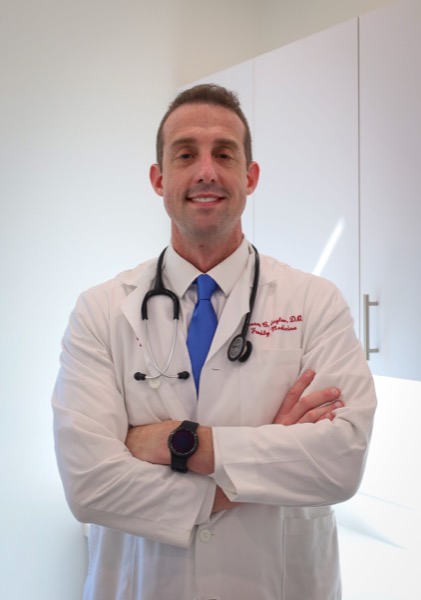
Riverview built the houses first. Anyone hunting for primary care in Riverview learns this quickly: the area roughly doubled its population in a decade, whole communities like Panther Trace and Triple Creek appeared where pasture used to be, and the count of physicians accepting new patients never kept pace. So the town runs on urgent care and long waitlists. Ascend Mind and Body serves Riverview from our Tampa-Carrollwood office at 3971 Moran Road, Suite 101, where Dr. Jason Saylor, DO, board-certified in family medicine with 17 years behind him, still takes new patients and still gives the first visit a full 45 to 60 minutes.
The town grew faster than its waiting rooms
Look at any school pickup line and the math explains itself. Tens of thousands of new residents arrived over a decade, and medicine followed the way it usually follows growth: retail-style. Walk-in clinics went up beside the grocery anchors, staffed for throughput, ideal for a Saturday ear infection and structurally incapable of knowing you. Meanwhile the established family practices in Brandon and south county filled their panels years ago. New arrivals call around and hear the same phrase on repeat: not accepting new patients, or an opening in four months.
The other tell is the signage. Medical plazas advertise walk-in hours and short waits, which sounds like access until you need the same clinician twice. Retail medicine measures itself in door-to-door minutes. Primary care measures itself in years, and years are exactly what that model can't stock.
The result is a community where thousands of people technically have healthcare access and practically have no doctor. That's the specific gap this page is about. And it's not an argument against growth, just an argument for picking one clinician while you still have the luxury of choosing calmly.
When every doctor is new to you, the first hour decides everything
Moving to a growth suburb usually severs medical continuity. Your old physician is in another state. Your records are scattered across whatever systems your last city used. Whoever you pick next starts blind, and if that next doctor gets twelve minutes with you, blind is how they stay. Small errors follow from that: the duplicate test, the medication nobody reconciled, the family history no one ever asked about.
Riverview's growth compounds the problem, because it often isn't just the doctor who's new. For a household that arrived recently, the pharmacy is new, the specialists are new, and the insurance network may have changed with the job that prompted the move. A thorough intake is the one appointment that can rebuild that scaffolding all at once.
This is why the length of the intake visit matters more in Riverview than almost anywhere else in Tampa Bay. When the physician is new to everyone, the practice has to be built to absorb histories, not just process complaints. Ours is. The first appointment runs 45 to 60 minutes, long enough for Dr. Saylor to actually read the record you bring, reconcile every medication including the supplements, examine you head to toe, and set a plan you had a voice in. You leave with a written summary in your patient portal, and the practice leaves with something Riverview's walk-in economy never generates: a real baseline.
A good baseline also changes the economics of every later visit. Once the history is in the chart, a brief video follow-up carries real weight, because it sits on top of an hour of groundwork instead of a blank page. Skip the groundwork and that leverage never exists.
What Dr. Saylor covers before he changes anything
The intake follows a deliberate order. History first, in your words and in the records, because half of good primary care is knowing what's already been tried. Then the physical exam. Then the gaps: baseline labs that are missing or stale get ordered, age-appropriate screening gets scheduled, vaccinations get caught up, cardiovascular risk gets assessed rather than assumed. Only after all that does the plan take shape, medications, referrals, follow-up cadence, each explained while you're still in the chair.
The exam itself stays unhurried enough to do the boring things properly: heart and lungs actually listened to, the checks your age and history call for rather than a one-size template, and in-office testing handled the same visit when clinically possible, instead of spawning a second appointment.
Preparation makes it work. Complete the intake forms online before the visit, gather your medication list and any prior records you can pull, and bring your insurance card so benefits are verified before you sit down. Quest Diagnostics and Labcorp both operate collection sites throughout the area, we send lab orders wherever suits you, and most results hit your portal within one to three business days.
The conditions that punish discontinuity hardest
Every condition we manage is manageable. What none of them tolerate is being managed by strangers in sequence. Hypertension drifts quietly between one-off visits; here it gets proper diagnosis, lifestyle work, medication titration, and monitoring by the same set of eyes. High cholesterol gets lipid panels read against your family history and an honest weighing of whether a statin belongs in your plan. Type 2 diabetes gets the full framework: A1c management, medication selection across metformin and the GLP-1 and SGLT2 classes where appropriate, dietary counseling, and referrals to ophthalmology and podiatry when indicated.
Hypothyroidism gets TSH monitoring and careful levothyroxine adjustment, with Hashimoto's evaluated when the pattern points there. Chronic pain is approached non-opioid first, with physical therapy referrals and tightly managed medication where it earns its place. Once stable, most chronic conditions settle into follow-up every three to six months. Acute problems, the respiratory infections, GI complaints, skin issues, and injuries of ordinary life, get worked in as they come; established patients can usually be seen the same week.
Two patterns deserve naming because we see so much of both. The first is the newcomer whose blood pressure or A1c hasn't been checked since the move, sometimes for years. The second is the patient whose refills have been kept alive by urgent care stopgaps without anyone re-evaluating the condition underneath. Both tend to walk in believing they're up to date. The baseline visit often says otherwise, and learning that at a scheduled physical beats learning it in an emergency room.
Reading your own lab results
Results now land in your portal, often before anyone has called about them, and that has created a specific modern anxiety: a page of numbers with a red flag next to one of them and no context at all. A little literacy here goes a long way, because most flagged values are not the emergency they look like, and a couple of unflagged ones matter more than people realise.
Start with what a reference range actually is. It is the interval containing the middle 95 percent of results from a reference population, which means that by construction about one in twenty healthy people falls outside it on any given test. Order a panel with fourteen analytes and the odds are better than even that at least one comes back flagged in a perfectly well person. A single value just outside the range, on its own, is usually noise. The same value drifting in one direction across three years is a finding.
A few specifics that come up constantly. A mildly low eGFR on one occasion in a well-hydrated adult often means very little; the same number twice, months apart, means something. Slightly elevated liver enzymes are extremely common and most often relate to fatty liver, alcohol, or a recent medication rather than to anything dramatic. A high white cell count during an obvious infection is the body doing its job. Cholesterol is not read as a pass or fail line but as one input into overall cardiovascular risk, which is why two people with identical LDL can get different recommendations.
The trend is nearly always more informative than the snapshot, and the snapshot is nearly always more alarming. This is one of the strongest arguments for staying with one practice: a result compared against your own results from two and four years ago carries far more information than the same result compared against a population range. Care assembled from a series of unconnected visits throws that comparison away every time.
What deserves a call rather than a wait: a value flagged as critical, a substantial change from your own baseline, or any result that arrives alongside symptoms. What deserves patience: a small deviation, on one occasion, with no symptoms, in a test that will be repeated anyway. And the useful habit is to bring the printout to the visit rather than the worry, because ten minutes on a result you can see beats a month of intermittent googling.
Ascend has no Riverview office. The in-person home for Riverview patients is our Tampa-Carrollwood office at 3971 Moran Road, Suite 101, Tampa, FL 33618, with Wesley Chapel at 27724 Cashford Circle, Suite 102 as the alternative for some schedules. Neither is around the corner, and pretending otherwise would waste your time.
Established patients mostly stay on video
Florida telehealth carries the maintenance load for established patients: medication refills, stable chronic-disease follow-ups, lab result reviews, and many simple acute issues. The boundary is clinical, not promotional. Annual physicals, new-patient evaluations, and any visit that needs auscultation, palpation, or in-office testing happen in person at Tampa-Carrollwood or Wesley Chapel, full stop.
Dr. Saylor sets your particular cadence at the first visit based on what's being treated, then adjusts it as your health changes. Most people land at one in-person visit per year with video check-ins between. The point isn't convenience for its own sake. It's that follow-through improves when following through doesn't cost half a day, and for a household juggling shift work and school pickups, that difference often decides whether follow-up happens at all.
What a video visit needs is unremarkable: a camera-equipped phone or computer, and you inside Florida at visit time. What it delivers is the part that matters, the same physician working from the same chart, minus the round trip. None of this replaces judgment, either. When something on a video call doesn't sit right, the answer is an exam, and the schedule makes room for one.
A physician, not a rotation
Continuity has a face here. Dr. Jason Saylor, DO is a board-certified osteopathic family medicine physician, trained at Philadelphia College of Osteopathic Medicine, with 17 years across urgent care and private practice. Seventeen years split between those two settings turns out to be useful preparation for a town like this one: he's seen what episodic medicine does well and where it quietly fails, and he built his own practice as the counterweight. He keeps his panel deliberately small, which is the structural decision behind everything else on this page: the long intakes, the same-week acute access, the fact that the person reviewing your February labs is the person who ordered them.
The DO letters mean he completed the same medical training as an MD plus additional musculoskeletal training and a whole-person orientation. DOs prescribe, order imaging, and refer to specialists exactly as MDs do. In the room it mostly shows up as attention: to sleep, to stress, to the connections between systems that a rushed visit never reaches. And when a specialist is needed, records move with your written consent by secure portal or fax, with Dr. Saylor staying on as the coordinator rather than handing you off into the void.
Mental health stays in-house too. Riverview patients can see psychiatry through Anna Stouffer, PMHNP-BC, or the talk therapy team, both by Florida telehealth.
Insurance we accept, and how self-pay works
Primary care here is in-network with Aetna, ChampVA, and UnitedHealthcare. Networks shift by carrier and by plan, so treat the list as a starting point: call (813) 670-3331 with your insurance card and we'll verify your specific benefits before your appointment. We won't bill you out-of-network for primary care without a clear cost conversation first; that's a standing rule, not a courtesy.
Without insurance, or with a deductible high enough that you're functionally paying cash, the cost depends on visit type and on any labs or procedures performed, which is why no flat-rate table is published on the site. The billing team gives you the exact number for your situation when you call, and the cash-pay options are worth asking about directly. Bring the physical card to the first visit even after phone verification, so the plan on file matches the plan you actually hold.
New-patient appointments are typically available within one to two weeks. Call (813) 670-3331, or book online, and if you need something fast once established, morning calls are when same-day openings surface. One last south county practicality: if your workday already takes you into Tampa, folding an in-person visit into it usually beats setting aside a separate morning.
Also see our nearby primary care options
Looking for in-person care, or comparing across south Tampa Bay clinics?
- Primary care in Tampa: in-person at our Carrollwood office
- Primary care in Wesley Chapel: in-person at our Pasco County hub
- Lakeland location: our Polk County office
- Primary care in Brandon: telehealth, neighboring east Hillsborough
- Primary care in St. Petersburg: across Tampa Bay
For mental health alongside primary care, see psychiatry in Riverview (Anna Stouffer, PMHNP-BC, via Florida telehealth) or talk therapy in Riverview (clinician team via Florida telehealth).
FAQs about primary care in Riverview
Why doesn't Ascend have a Riverview primary care office?
We focus on three physical locations (Wesley Chapel, Tampa-Carrollwood, and Lakeland). Ascend has no Riverview office. Tampa-Carrollwood, at 3971 Moran Road, Suite 101, Tampa, FL 33618, is the closest in-person primary care clinic for Riverview residents. Wesley Chapel, at 27724 Cashford Circle, Suite 102, Wesley Chapel, FL 33544, is the other option.
Can primary care be done via telehealth?
Some primary care can - medication refills, stable-condition follow-ups, lab review, simple acute issues. Annual physicals and any visit requiring a hands-on exam need to be in person. Dr. Saylor sets the cadence and modality with you at your first appointment based on what you're being treated for.
How quickly can I get an appointment?
New patient appointments are typically available within 1-2 weeks. Established patients with acute issues can usually be seen the same week. Call (813) 670-3331 in the morning to ask about same-day availability.
Where do I get my labs drawn?
Quest Diagnostics and Labcorp both operate collection sites throughout Riverview, Brandon, and Apollo Beach. We send the orders to whichever location is most convenient. Results post to your patient portal within 1-3 business days for most panels.
What is the difference between a DO and an MD?
Doctors of Osteopathic Medicine (DOs) complete the same medical training as MDs plus additional training in the musculoskeletal system and a whole-person approach. DOs prescribe medication, order imaging, and refer to specialists exactly like MDs. The philosophical difference is integrative - treating the whole patient, not just the disease.
Will Dr. Saylor coordinate with my specialists?
Yes. With your written consent, we exchange records with your specialists by secure fax or portal. Care coordination is a core part of primary care, especially for patients with multiple chronic conditions or active treatment with cardiology, endocrinology, or other subspecialties.