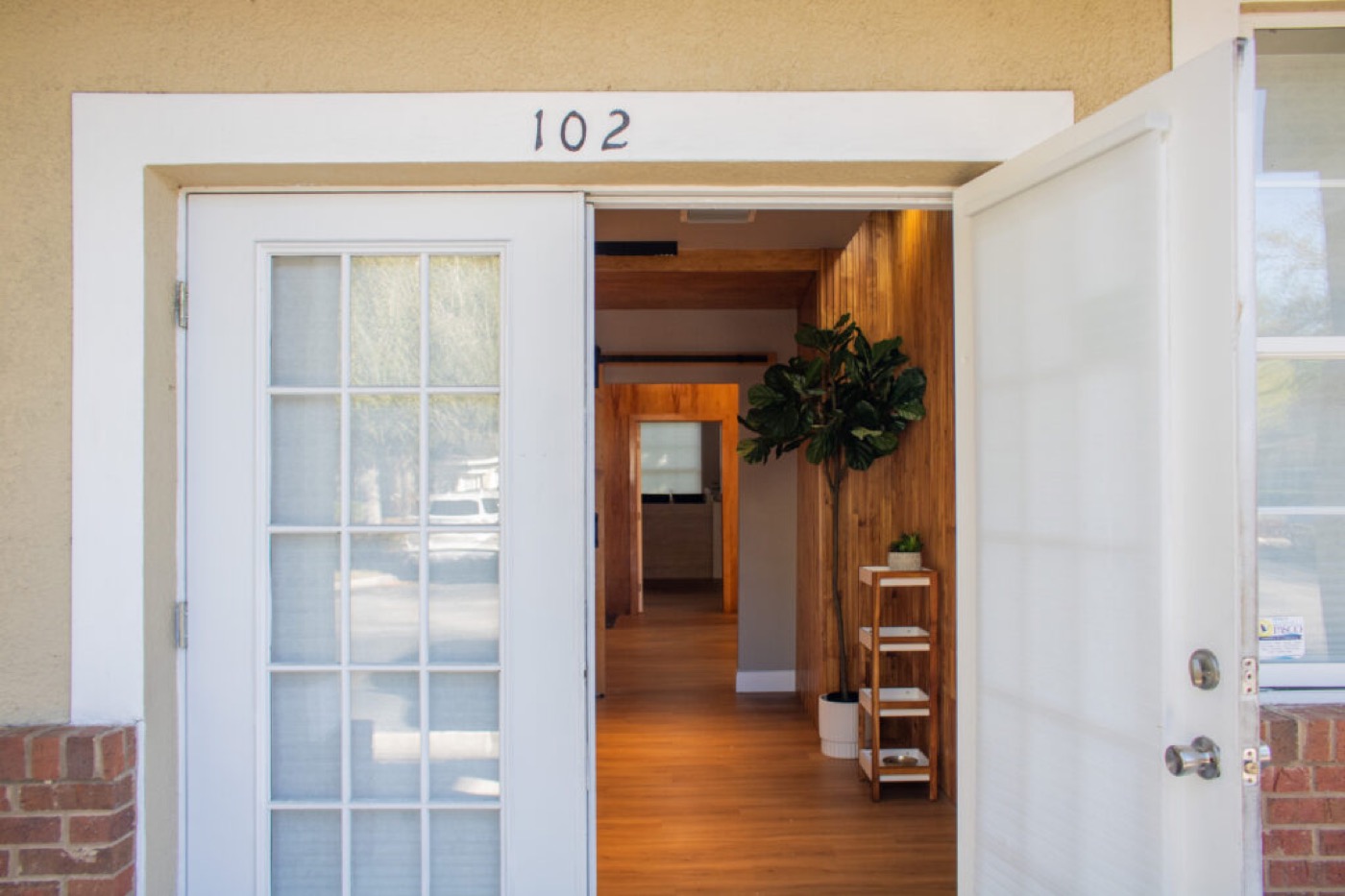
This is the room. Cashford Circle is where Anna Stouffer actually sits, which makes it the one address in the practice where a psychiatric appointment is a physical appointment by default rather than by request. It is also the only Ascend location carrying every service line at once, so primary care with Dr. Saylor, talk therapy, and supervised ketamine therapy are all reachable from the same waiting area and the same chart.
Most of this page is about what that physical presence buys you clinically, because the honest answer is: more than the marketing usually claims, and less than nothing in some areas. Both halves are below.
Anna Stouffer, PMHNP-BC, and what dual certification changes in the room
Anna Stouffer, PMHNP-BC holds two board certifications, psychiatric mental health nurse practitioner and family nurse practitioner, with more than 10 years of clinical experience. In an exam room that combination is not an abstraction. It means the person adjusting your antidepressant is also the person who takes your blood pressure, notices a five-kilogram gain since March on a metabolically active medication, asks about snoring before blaming the fatigue on depression, and orders the thyroid panel herself rather than writing you a note to take somewhere else.
Cashford Circle is her home office. She also covers Lakeland and Polk County by telehealth and sees Tampa-area patients mainly by video, with the drive north up I-75 available to anyone who prefers the room. Across the practice she is the named psychiatric prescriber, so continuity is structural rather than aspirational.
What Pasco County adults come in for
The presentations that fill the Wesley Chapel psychiatric schedule. Each links through if you want the clinical detail:
Beyond those, Anna manages perinatal mood presentations, premenstrual dysphoric disorder, and treatment-resistant cases where ketamine therapy in this same building becomes a clinical question. Individual responses vary and no patient is treated as certain to respond.
What an in-person psychiatric visit here includes
The evaluation, 60 to 75 minutes
A full diagnostic interview with the medical history running alongside the psychiatric one, family history, and a careful pass through every previous medication: what dose, how long, what made you stop. Validated instruments are chosen to fit the presentation rather than handed out uniformly. You leave with a working diagnostic impression rather than a prescription and a shrug, and anything prescribed goes electronically to your pharmacy. In the room this also includes the parts a form cannot collect, which are covered further down.
Follow-ups, and the numbers taken at each one
Twenty to thirty minutes, and the working pharmacology is unremarkable: antidepressants acting on serotonin alone or on serotonin and noradrenaline together, ADHD agents both stimulant and non-stimulant, lithium and the anticonvulsant mood stabilizers, second-generation antipsychotics used for bipolar presentations and for augmentation, and anxiolytics prescribed sparingly. What separates a room visit from a video one is measurement. Blood pressure and pulse are taken, not asked about. Weight is on a scale rather than a memory. Cardiac tracing is arranged when a medication warrants it, and monitoring bloodwork is ordered from here or to whichever Quest or LabCorp site you prefer.
The ADHD workup, done in the room
The largest share of new bookings at this office, and the one where a rushed process causes the most harm. Standardized rating scales, a childhood symptom timeline that specifically revisits elementary and middle school, and a deliberate rule-out of the mimics, which in this office most often means undiagnosed sleep apnea, sustained short sleep, thyroid dysfunction, a depressive or anxious presentation doing the work, or a substance pattern nobody has asked about. Stimulant and non-stimulant options are compared only after criteria are met. Being in the room adds a resting pulse and blood pressure before any stimulant decision, which is the single measurement most worth having and the one a camera cannot supply. Anna does not write a stimulant off a fifteen-minute screen, and the structure of the visit is the reason why.
Sorting bipolar from unipolar
Bipolar I, bipolar II, cyclothymic presentations, and unipolar depression with mixed features are not interchangeable, and the distinction drives the medication choice more than almost anything else in the interview. Where someone arrives on antidepressant monotherapy but the history actually fits bipolar II, that conversation happens directly. Lithium prescribing brings recurring renal and thyroid labs, ordered and tracked in the same chart your therapist and physician are already writing in.
Prescribing that supports trauma work
Medication is rarely the whole answer in trauma, and saying otherwise sets people up for disappointment. Anna selects among serotonergic and dual-action agents guided by their current product labelling and the VA and Department of Defense clinical practice guideline, uses prazosin where trauma-related nightmares are prominent, and is explicit about what pharmacology can and cannot reach. The processing work itself happens with our therapy team or a referred trauma specialist, using EMDR, cognitive processing therapy, or trauma-focused CBT.
When the antidepressants have run out
For patients who have completed multiple trials at adequate dose and duration without adequate response, Anna assesses whether ketamine therapy is clinically appropriate. The program runs in this building under this psychiatric team, so the assessment, the treatment, and the follow-up sit in one record. Candidacy is decided case by case and nobody is treated as certain to respond.
Prescribing in pregnancy and while nursing
Mood and anxiety presentations arising during pregnancy, plus depressive, anxious, and obsessive-compulsive symptoms in the months after delivery. The decision is a comparison between the documented risks of an exposure and the documented risks of leaving an illness untreated in a pregnant or nursing parent, weighed against current Reprotox and LactMed evidence. In-person review matters here for an ordinary reason: blood pressure, weight trend, and sleep are all part of the picture, and all three are measured rather than reported.
What the room shows that a screen does not
A video visit is a good tool and this practice runs plenty of them. It is also, plainly, a narrower channel. Four things reliably fall out of it.
Movement. A tremor visible only when the hands are at rest, a stiffness that suggests a medication effect rather than a mood symptom, psychomotor slowing that reads as thoughtfulness on a laptop and as something else entirely across a desk. How somebody walks from the waiting room is data, and it arrives before the first question.
Vitals. Blood pressure and pulse before a stimulant decision. A weight trend on a metabolically active medication measured rather than estimated. Cardiac tracing when a rhythm question is live. None of these are obtainable by camera, and each of them changes prescribing.
The bottles. Patients are asked to bring the actual containers, not a typed list. The bottles carry the prescriber name, the fill date, and the pill count, which together answer questions a list never does: whether the prescription was ever filled, whether two clinicians are treating the same thing without knowing it, and how much is actually being taken. Roughly this is the highest-yield ten minutes of a follow-up.
Who came with you. Whether somebody drove you, whether they wait outside or come back, and what they add when invited into the last five minutes. Collateral history is often the part that reframes the whole case, and it is much harder to arrange through a link.
The honest counterweight: the room does not make the interview better on its own, it does not shorten a waitlist, and for a stable patient on an unchanged regimen a fifteen-minute drive buys very little. That is precisely why the next section exists.
Your first appointment at Cashford Circle, start to finish
Beforehand. Intake forms and rating scales are completed online, which keeps the appointment itself for conversation. Bring your medication containers rather than a list. If a prior psychiatrist, therapist, or physician holds relevant records, sign the release ahead of time so the request is already moving before you arrive.
Arriving. Free parking at the building, first-floor suite, no stairs or elevator between the lot and the front desk. Several service lines share the entrance, so nothing about sitting in the waiting area indicates which one you are here for.
In the room. Vitals first, then the interview: symptoms and their timeline, sleep, appetite, energy, concentration, mood pattern, family history, substance use, and a direct question about thoughts of self-harm. The interview is long because a wrong baseline costs months later. Complicated presentations sometimes need a second visit before any recommendation is finalized, and being told that is a better outcome than being handed a prescription to justify the appointment.
Afterwards. Prescriptions go electronically to your pharmacy. Titration follow-ups usually land every four to six weeks, stretching to every one to three months once things hold steady, and to twice yearly with portal messaging for patients stable long term.
When video is fine, and when we ask you to come in
Being the in-person office does not mean insisting on it. Video is genuinely fine for a stable regimen, a routine refill review, a check-in during a week that has gone sideways, and for anyone whose work makes a daytime drive unrealistic.
We ask for the room when a first evaluation is diagnostically murky, when a stimulant decision is on the table and current vitals are needed, when a medication change requires measurement rather than self-report, when there is a movement or neurological question, and when ketamine therapy is being scheduled alongside a psychiatric follow-up on the same trip. Patients across Pasco County, eastern Hillsborough, and the Lutz and Land O’ Lakes corridor generally reach the office in 10 to 25 minutes, which is why in-person stays the default here rather than an occasional event.
Coverage and self-pay at the flagship
Anna Stouffer is in-network for psychiatric care with major commercial and government plans. The insurance page carries the current matrix, and it does change as credentialing changes, so treat that page as the live answer rather than this paragraph. Benefits are checked before the first visit, which means the number is known before you check in rather than after.
Self-pay rates are given when our team calls you back; call (813) 670-3005 to get the figure before you schedule. Payment by HSA or FSA card is accepted here, financing through CareCredit and Cherry is available, and a superbill is issued so you can file out of network yourself.
Finding the office
Ascend Mind and Body - Wesley Chapel (Flagship)
27724 Cashford Circle, Suite 102
Wesley Chapel, FL 33544
Phone: (813) 670-3005
Fax: 844-548-7006
Hours: Monday through Friday, 8:00 AM to 5:00 PM
The suite sits near SR-54 and Meadow Pointe Boulevard, roughly two minutes from the Shops at Wiregrass. Parking is free and at the building itself, and Suite 102 is on the first floor, ADA-accessible, with no stairs or elevator between the car and the front desk. Patients come from Wesley Chapel, Land O’ Lakes, Lutz, New Tampa, Trinity, and the wider Pasco and north Hillsborough corridor.
Worth knowing before a late-afternoon appointment: the lot is shared and it does tighten after four o’clock, because every Ascend service line runs out of this address.
Psychiatry from nearby Pasco and north Hillsborough
Trying to work out the right entry point for someone else in the area? These cover the same psychiatric service from the surrounding communities:
Land O' Lakes
Telehealth psychiatry for the SR-54 corridor. In-person at Wesley Chapel about 20 minutes east.
Land O' Lakes Psychiatry →Lutz
Telehealth psychiatry for north Hillsborough. In-person at Wesley Chapel about 15 minutes east on SR-54.
Lutz Psychiatry →New Tampa
Telehealth psychiatry for 33647. In-person at Wesley Chapel about 10 minutes north on Bruce B Downs.
New Tampa Psychiatry →Questions from Wesley Chapel patients
Why bother coming in if video appointments exist?
For a stable regimen, often you should not, and we will say so. The room earns its keep when measurement matters: blood pressure and pulse before a stimulant decision, a real weight on a real scale during a metabolic-risk medication, a movement or neurological question, or a first evaluation where the diagnosis is genuinely unclear.
What should I physically bring to the first visit?
Your actual medication containers rather than a typed list. The labels carry the prescriber, the fill date, and the count, which together reveal whether a prescription was ever filled, whether two clinicians are treating the same thing unknowingly, and what is genuinely being taken. Old records help too; sign the release ahead of time so the request is already moving.
Who is the prescriber, and is a PMHNP different from a psychiatrist?
Anna Stouffer, PMHNP-BC. Both roles diagnose and prescribe, including controlled substances, and in Florida a PMHNP holds full prescriptive authority. The training route differs: a nurse practitioner completes graduate psychiatric mental health training, while an MD or DO completes medical school and a psychiatric residency. Anna also holds family nurse practitioner certification, which is where the medical-side awareness comes from.
How quickly can I get in?
New psychiatric patients are commonly scheduled one to two weeks out at this office, against a Florida norm of three to six months for new-patient psychiatry. Same-week and occasional same-day openings appear when other appointments move; call (813) 670-3005 early in the day if timing is pressing.
Can I have psychiatry, primary care, therapy, and ketamine at one address?
Yes, and Cashford Circle is the only Ascend location where that is true. Dr. Saylor covers primary care here, the therapy team works out of the same suite, and the ketamine program is supervised in this building. One chart, direct coordination, no records being faxed between systems.
Is bloodwork done at the office or somewhere else?
Either. Monitoring labs such as lithium levels, thyroid panels, and metabolic screening can be ordered from here or sent to whichever Quest or LabCorp site is convenient for you. Results return to Anna in the same record.
Do you prescribe stimulants for ADHD?
When it is clinically appropriate and only after a structured evaluation: rating scales, a childhood symptom timeline, and a rule-out of look-alike conditions including sleep apnea and thyroid dysfunction. Current vitals are taken in the room before any stimulant decision. Non-stimulant options are discussed alongside, not as a consolation.
I am pregnant or nursing. Is medication off the table?
No, and neither is it automatic. It is a risk-benefit comparison between a documented exposure and a documented untreated illness, worked through with current Reprotox and LactMed evidence. Being seen in person helps, because blood pressure, weight trend, and sleep are all part of the assessment and all three are measured here.
What happens if antidepressants have not worked for me?
Anna first checks whether the previous trials were genuinely adequate in dose and duration, since a surprising share were not. If they were, the next question is whether ketamine therapy in this building is clinically appropriate for you. Candidacy is decided individually and responses vary between patients.
Can somebody come into the appointment with me?
Yes, with your consent, and it is often useful. A partner or family member frequently supplies the detail that reframes a case, particularly around sleep, irritability, and how long a pattern has actually been running. You decide whether they join for the whole visit or only the last few minutes.
The guidance behind these decisions
The instruments and prescribing frameworks named above follow current published guidance and active product labelling. The primary sources are readable directly:
- Drugs@FDA database (accessdata.fda.gov). Medication selection at Ascend is made against each product’s current labelling, which is the document this database holds and which patients can read for themselves.
- VA/DoD Clinical Practice Guideline for the Management of PTSD (healthquality.va.gov). Used as the framework for medication selection and trauma-focused therapy referral pathways.
- National Institute of Mental Health: Bipolar Disorder (nimh.nih.gov). The bipolar I and bipolar II differential workup at Ascend follows NIMH and APA guidance plus structured screening (MDQ).