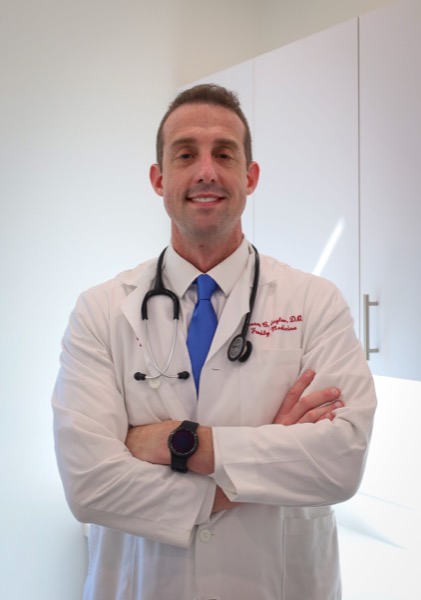
Central Pasco grew faster than its medical bench, and the search for primary care in Land O' Lakes runs straight into that. A new subdivision opens, several hundred households arrive, and the number of family physicians accepting new patients does not move. Connerton and Bexley added thousands of front doors faster than central Pasco added family physicians, so the adults in most of these households are patched together across urgent cares, an old doctor from two moves ago, and whoever the insurance app suggested. Ascend Mind and Body's offer is simpler: Dr. Jason Saylor, DO, board-certified in family medicine, 17 years in, at our Wesley Chapel office, 27724 Cashford Circle, Suite 102. Call (813) 670-3331 or book online.
Doctor logistics, for households that run on a schedule
Talk to the parents of young kids about healthcare and the conversation is never really about medicine; it's about logistics. The pediatrician got chosen carefully. The adults' own care is whatever fit in the cracks, which usually means it didn't happen. A physical postponed three times. A blood pressure prescription refilled by a walk-in clinic that's never seen the chart. A thyroid dose unchanged since 2022 because rechecking it means a half day off work.
The fix isn't discipline; it's shrinking the footprint of each medical task until it fits inside a normal week. That's the design principle behind how this practice serves central Pasco. One in-person anchor visit a year, close enough to reach between obligations. Telehealth for the routine middle. Lab draws at whichever Quest Diagnostics or Labcorp site is already on your route, they operate across Land O' Lakes, Wesley Chapel, and Lutz, with results in your patient portal within 1 to 3 business days for most panels. A refill becomes a video call from the laundry room, not an errand.
Medication reconciliation: the list nobody keeps
Ask an adult with two chronic conditions to name everything they take, with doses, and most people get about three quarters of the way there. That gap is not carelessness. Prescriptions accumulate across a specialist, an urgent care, a dentist, and a doctor from two moves ago, and no single system ever assembles them into one list. Reconciling that list is one of the least glamorous and highest-value things a family physician does, and it is a real agenda item here rather than a box on an intake form.
What we ask you to bring is the actual containers, or a photograph of them, rather than a remembered list. That includes the things people systematically omit: over-the-counter pain relievers, antacids, sleep aids, allergy medication, vitamins, herbal supplements, protein powders with active ingredients, and anything prescribed by a specialist that you assume we already know about. It also includes what you have stopped taking and why, because a medication discontinued for a side effect is important information that otherwise gets rediscovered the hard way when someone prescribes it again.
The reconciliation itself is looking for four things. Duplication, where two prescribers have independently covered the same problem, sometimes with the same drug under different names. Interaction, which is where the over-the-counter and supplement omissions do the most damage, because several common ones interact meaningfully with blood thinners, thyroid medication, and blood pressure drugs. Drift, where a dose was raised for a temporary reason years ago and never came back down. And orphans, where the condition a medication was started for no longer exists but the prescription auto-refills anyway.
The last of those is worth its own sentence, because it is common and quietly consequential. Deprescribing, meaning deliberately stopping something that is no longer earning its place, gets far less attention than starting things does. Every medication has a cost in side effects, interactions, and money, and a list that only ever grows is a list nobody has audited. Once a year, at minimum, somebody should be asking of each item on it: is this still doing what it was started to do?
In-person visits are reserved for the things that need them: new-patient evaluations, annual physicals, and anything involving auscultation, palpation, or in-office testing. Established patients handle the rest by Florida telehealth, medication refills, stable chronic-disease follow-ups, lab reviews, and simple acute issues, with Dr. Saylor deciding the right mix with you at the first appointment based on what's being treated. For a two-adult household with typical chronic conditions, that usually works out to two annual physicals and a scattering of video check-ins per year.
Ascend has no office in Land O' Lakes itself. In-person visits happen at our Wesley Chapel flagship, 27724 Cashford Circle, Suite 102, or at Tampa-Carrollwood, 3971 Moran Road, Suite 101, and Dr. Saylor sees patients at both, so the choice is yours visit by visit.
One practice for the adults under your roof
There's a quiet advantage to the adults in a household seeing the same family physician, and it has nothing to do with convenience. Health context is shared context. The same clinician hearing about both partners' sleep, stress, and workload spots things a stranger wouldn't: that both blood pressures crept up the same year, that one person's insomnia started when the other's shift changed. Nothing about your spouse's record is ever visible to you or vice versa, privacy is absolute, but the physician's understanding compounds, and coordinating something as simple as back-to-back appointment slots gets easier.
It also collapses the mental load, which for the scheduling parent is not a small benefit but the whole ballgame. One phone number, (813) 670-3331, one portal, one billing conversation, one practice that already has both charts when a bug tears through the house. Nobody maintains a spreadsheet to remember who goes where. And when the thing weighing on an adult in the household is mood, anxiety, or burnout rather than blood pressure, the practice has in-house paths for that too: psychiatry with Anna Stouffer, PMHNP-BC, and talk therapy with the therapy team, both via Florida telehealth. To be clear about scope: this page covers care for adults; it's the grown-ups' chart, not a pediatric one.
Same-week sick visits, because life doesn't book two weeks out
Access is where most primary care quietly fails working families. A doctor you can't see when you're actually sick trains you to use urgent care, and the relationship dissolves from disuse. This practice holds the line in the other direction: established patients with an acute issue can usually be seen the same week, and calling in the morning is the best way to ask about same-day availability. New patients typically get a first appointment within 1 to 2 weeks. Respiratory infections, GI complaints, skin flare-ups, minor injuries, the ordinary casualty list of a busy household, get handled by the physician who has your history, sometimes by video when the problem is simple enough, in person when it isn't.
The panel is kept deliberately small to make that possible. The regional norm of a physician spread across thousands of patients is precisely what turns "call your doctor" into a punchline; a smaller panel is the unglamorous structural fix.
There's a household multiplier on this, too. Illness in a family with young kids rarely travels alone; whatever the elementary school is passing around tends to reach the parents by the weekend. When both adults are patients of the same practice, the second case doesn't start from scratch. The physician already knows what the first adult tested positive for, what was prescribed, and how it went, which makes the second evaluation faster and the treatment choices smarter. That's a small thing until the week it isn't.
Video visits that fit between drop-off and practice
Here's what telehealth actually looks like for a central Pasco household once you're established. A refill check-in scheduled for the twenty minutes after school drop-off, taken from wherever you happen to be sitting, is a perfectly good medical appointment. So is a lab review from the kitchen while dinner cooks, or a quick evaluation of a lingering cough before deciding whether it needs to be seen in person. The technology bar is deliberately low: any phone, tablet, or computer with a camera does the job, and nobody minds a toddler wandering through the frame.
The honest boundaries matter as much as the convenience. Video handles refills, stable chronic-disease check-ins, lab results, and simple acute complaints. It cannot listen to lungs, press on an abdomen, or run an in-office test, so anything in that category gets converted to an in-person slot, usually at Wesley Chapel since it's the near office. That conversion isn't a failure of the model; it's the model working. The physician on the screen is the same one who'll examine you in the room, reading the same chart, which is exactly what the app-based telehealth vendors can't offer. Prescriptions go to your usual pharmacy, and portal messages cover the small questions that never deserved an appointment in the first place.
What Dr. Saylor treats, and how he works
The clinical core is adult family medicine done thoroughly. Hypertension: a real diagnosis first, then lifestyle work, dose titration, and monitoring that doesn't lapse when life gets busy. High cholesterol: lipid panels, statin discussion, family-history risk assessment. Type 2 diabetes: A1c management with medication selection spanning metformin, SGLT2 inhibitors, and GLP-1 agents where appropriate, plus dietary counseling and specialty referrals when the eyes or feet need them. Hypothyroidism: TSH monitoring, levothyroxine titration, Hashimoto's evaluation. Chronic pain: non-opioid approaches first, PT referrals, medication managed judiciously. Preventive screenings: age-appropriate cancer screening, vaccinations, baseline labs, cardiovascular risk assessment.
Dr. Saylor earned his DO at Philadelphia College of Osteopathic Medicine, is board-certified in family medicine, serves as Chief Medical Officer of the practice, and spent his 17 years across urgent care and private practice. Osteopathic physicians train exactly as MDs do, then add musculoskeletal work and a whole-person orientation; functionally he prescribes, images, and refers like any physician, and philosophically he starts with your life before your labs. When specialists are involved, records move with your written consent via secure fax or portal, and he stays the hub of the wheel.
From first appointment to a settled rhythm
Getting started is deliberately light. Book by phone or online, knock out the intake forms from your couch, and show up with three things: a complete medication list including supplements and over-the-counter items, any prior records you want in the chart, and your insurance card so benefits get verified before the visit.
First appointments run 45 to 60 minutes, long enough for a genuine history, a physical exam, the concern that brought you in, and baseline labs if yours are out of date. You'll have a written summary in the portal before dinner. That length isn't a luxury; it's load-bearing. A physician can't set a sensible follow-up plan for someone whose history he got in seven minutes, and the whole point of this practice is that the plan gets set right the first time. After that, the rhythm sets itself: the annual physical in person as the fixed point, stable chronic conditions rechecked every 3 to 6 months, mostly by telehealth once things are steady, and sick visits slotted in as the household produces them. It's the cadence of a practice designed around people with calendars, which around here is everyone. Once it's running, healthcare stops being a project you administer and becomes a utility that's simply on.
Insurance, verification, and self-pay handled up front
The practice is in-network for primary care with Aetna, ChampVA, and UnitedHealthcare. In-network status differs by carrier and by plan, and the accepted list changes over time, so call (813) 670-3331 with your card and the team will confirm your specific plan and verify benefits before anyone examines you. A firm rule backs that up: no out-of-network billing for primary care without a clear conversation about cost first.
Households without matching coverage, or carrying deductibles high enough that they're effectively self-pay, should ask about cash-pay options on the same call. Because the cost of a visit turns on its type, initial or established, video or in-office, and on any labs or procedures done that day, the website doesn't carry a flat-rate sheet; the billing team gives you the exact number by phone. For a family budgeting around two adults' worth of care, that one phone conversation up front beats guessing, and it's the same number you'll use for everything else anyway.
Beyond Land O' Lakes proper (34637, 34638, 34639), the practice serves Wesley Chapel (33543, 33544, 33545), Lutz (33548, 33549, 33558, 33559), and Odessa (33556). Neighbors to the south can compare primary care in Lutz or primary care in Tampa; eastern Hillsborough has primary care in Brandon; and the Wesley Chapel primary care page covers the closest office in detail.
Also see our nearby primary care options
Looking for in-person care, or comparing across Tampa Bay clinics?
- Primary care in Wesley Chapel: in-person at our Pasco County hub (legal practice address)
- Primary care in Lutz: neighboring Hillsborough County
- Primary care in Tampa: in-person at our Carrollwood office
- Primary care in Brandon: eastern Hillsborough County
For mental health alongside primary care, see psychiatry at Ascend (Anna Stouffer, PMHNP-BC, via Florida telehealth) or talk therapy (therapy team via Florida telehealth).
FAQs about primary care in Land O' Lakes
Why doesn't Ascend have a Land O' Lakes primary care office?
We focus on three physical locations (Wesley Chapel, Tampa-Carrollwood, and Lakeland). Ascend has no Land O' Lakes office. Wesley Chapel, at 27724 Cashford Circle, Suite 102, Wesley Chapel, FL 33544, is the closest in-person primary care clinic for Land O' Lakes residents. Tampa-Carrollwood, at 3971 Moran Road, Suite 101, Tampa, FL 33618, is the other option.
Can primary care be done via telehealth?
Some primary care can - medication refills, stable-condition follow-ups, lab review, simple acute issues. Annual physicals and any visit requiring a hands-on exam need to be in person. Dr. Saylor sets the cadence and modality with you at your first appointment based on what you're being treated for.
How quickly can I get an appointment?
New patient appointments are typically available within 1-2 weeks. Established patients with acute issues can usually be seen the same week. Call (813) 670-3331 in the morning to ask about same-day availability.
Where do I get my labs drawn?
Quest Diagnostics and Labcorp both have draw sites across Land O' Lakes, Wesley Chapel, and Lutz. We send the orders to whichever location is most convenient. Results post to your patient portal within 1-3 business days for most panels.
What is the difference between a DO and an MD?
Doctors of Osteopathic Medicine (DOs) complete the same medical training as MDs plus additional training in the musculoskeletal system and a whole-person approach. DOs prescribe medication, order imaging, and refer to specialists exactly like MDs. The philosophical difference is integrative - treating the whole patient, not just the disease.
Will Dr. Saylor coordinate with my specialists?
Yes. With your written consent, we exchange records with your specialists by secure fax or portal. Care coordination is a core part of primary care, especially for patients with multiple chronic conditions or active treatment with cardiology, endocrinology, or other subspecialties.