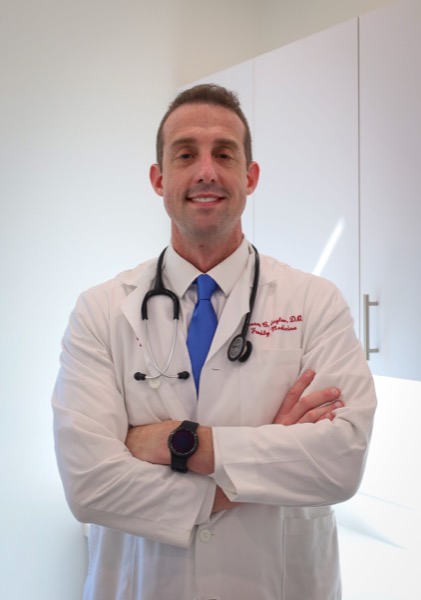
If you've gone looking for primary care in Apollo Beach, you already know the punchline: the doctor is somewhere else. The rooftops came fast here, through MiraBay, Waterset, and the newer inland subdivisions, and the medical infrastructure never quite caught up. Ascend Mind and Body doesn't pretend otherwise. There is no Ascend office in Apollo Beach. What we offer instead is a specific trade: family medicine with Dr. Jason Saylor, DO, a board-certified osteopathic family physician with 17 years of clinical experience, seen in person at our Tampa-Carrollwood office at 3971 Moran Road, Suite 101, with Florida telehealth carrying most of the routine follow-up load after that. Call (813) 670-3331 or book online.
Why "my doctor" means somewhere else when you live in Apollo Beach
Apollo Beach is a boating town that turned into a bedroom community almost overnight. The canals filled in with homes decades ago; the newer growth pushed inland, and the commercial strip answered with grocery anchors, chain restaurants, and a couple of walk-in clinics. What it didn't produce was a deep bench of physicians taking new patients. Ask a neighbor in MiraBay who their doctor is and the answer usually names Brandon, Riverview, Sun City Center, or Tampa. Looking outside town was already part of the deal before you ever picked a practice.
That reframes the decision in a useful way. Once you accept that your physician is going to be based somewhere other than Apollo Beach, proximity stops being the tiebreaker. The tiebreaker becomes what happens inside the visit. A practice where the physician carries a panel of thousands and runs twelve minutes behind all day is not worth a drive. A practice built around a deliberately smaller panel, longer appointments, and a doctor who reads your chart before walking in might be. That second model is the one we run, and this page lays out how it works from a 33572 zip code.
To be fair to the local options: the walk-in clinics handle what they're built for, a strep swab, a stitched finger, a Sunday ear infection. What they can't do, by design, is own anything that unfolds over months or years. Respiratory infections, GI complaints, skin problems, and minor injuries all deserve a clinician who will still be your clinician at the follow-up, and that's the gap this arrangement closes.
One visit in person, then telehealth carries the rest
Here's the math that makes this arrangement work for South Shore residents. Your new-patient visit and your annual physical happen in person, because they should; you can't listen to a heart over video. For an Apollo Beach patient that means our Carrollwood clinic at 3971 Moran Road, Suite 101, and Ascend has no location in Apollo Beach itself.
Nearly everything between those in-person anchors can happen from your kitchen table. Once you're an established patient, Florida telehealth covers medication refills, stable chronic-disease follow-ups, lab review, and simple acute issues. Anything that requires hands on you, auscultation, palpation, in-office testing, a new-patient evaluation, gets scheduled in person at Tampa-Carrollwood or at our Wesley Chapel office at 27724 Cashford Circle, Suite 102, whichever suits your week better. Dr. Saylor sets the cadence and the mix of visit types with you at the first appointment, based on what you're actually being treated for. In practice, most established South Shore patients settle into one in-person visit a year plus video check-ins as needed.
A video visit itself is unremarkable, which is the point. You need a phone, tablet, or computer with a camera and a quiet ten minutes; the boat can stay in the water. Refills go straight to your pharmacy, follow-up labs get ordered to a collection site near home, and the note lands in the same portal your in-person visits use. The chart doesn't care which format the appointment took, and neither does the physician reading it, because it's the same physician every time. That continuity is what separates this from the app-based telehealth services where each session starts with a stranger asking you to spell your medication names.
Chronic conditions, managed with actual follow-through
Chronic disease management is where the difference between a real primary care relationship and a string of walk-in visits shows up in your labs. Blood pressure that gets measured once a year at an urgent care isn't managed; it's observed. Managing it means a diagnosis you trust, a medication started at a sensible dose, a follow-up where the numbers get checked, and a titration when they're not where they should be. That loop, check, adjust, recheck, is the whole job, and it's the part that falls apart when no single physician owns your chart.
Dr. Saylor runs that loop across the conditions that fill most family medicine panels: hypertension with ongoing monitoring and dose adjustments, high cholesterol with lipid panels and an honest statin conversation, type 2 diabetes with A1c tracking and medication selection across metformin, SGLT2 inhibitors, and GLP-1 agents where appropriate, and hypothyroidism with TSH monitoring and levothyroxine titration. Chronic pain is handled with non-opioid approaches first, physical therapy referrals, and careful medication management where medication belongs. Preventive screenings round it out: age-appropriate cancer screening, vaccinations, baseline labs, and cardiovascular risk assessment. Sick visits fill the gaps between physicals, and the next section covers how those work when the office is not in your town.
When something goes wrong on a random Tuesday
Primary care proves its worth on the ordinary bad days, not the annual ones. A cough that's hung on too long, a rash that appeared after a weekend on the water, a stomach bug making its way through the house off Symmes Road. The reflex in Apollo Beach has always been the walk-in clinic, because what else was there? With an established relationship, the reflex changes: you call the office, and the person deciding what happens next already has your history open. Established patients with an acute issue can usually be seen the same week, and a morning phone call is the way to ask about same-day availability.
Plenty of these visits never require an in-person appointment at all. A simple acute issue can often be evaluated over video, with an in-person slot at Carrollwood or Wesley Chapel reserved for anything that needs eyes, hands, or a stethoscope on you. Either way, the treatment decision gets made by a physician who knows your medication list, your allergies, and your last set of labs, which is precisely the context a walk-in visit can't have. New patients aren't left out of the access picture either; a first appointment is typically available within 1 to 2 weeks.
The first visit: what that hour actually covers
Plan on 45 to 60 minutes for the initial appointment, which is longer than many Apollo Beach residents have ever spent with a physician who wasn't stitching something. Before you come in, you'll complete intake forms online and gather your current medications, including over-the-counter drugs and supplements, plus any prior records worth reviewing. Bring your insurance card so benefits can be verified before you sit down.
The visit itself is a full accounting. Dr. Saylor goes through your history, performs a physical exam, and works the problem you came in with. If baseline labs haven't been done recently, he orders them; Quest Diagnostics and Labcorp both run draw sites across Apollo Beach, Riverview, Sun City Center, and Brandon, so the blood draw rarely requires a separate trip. Results post to your patient portal within 1 to 3 business days for most panels, and you leave the appointment with a written summary in that same portal. From there the rhythm is predictable: annual physicals as the cornerstone, chronic conditions followed every 3 to 6 months until stable, acute issues handled as they surface.
About Dr. Jason Saylor, DO
Dr. Saylor earned his Doctor of Osteopathic Medicine from Philadelphia College of Osteopathic Medicine and is board-certified in family medicine. His 17 years span urgent care and private practice, which turns out to be a useful combination: he's seen what episodic medicine misses, and he built his practice around not missing it. He also serves as the practice's Chief Medical Officer. Patients tend to describe the same experience: he sits down, he listens, and he treats the person rather than the chief complaint.
The DO training matters here in a concrete way. Osteopathic physicians complete the same medical education as MDs, prescribe, order imaging, and refer identically, with additional training in the musculoskeletal system and a whole-person orientation. In the exam room that shows up as time spent on sleep, stress, work, weight, and family history, the context that explains why your numbers look the way they do. When your care needs a cardiologist or endocrinologist, records move with your written consent by secure fax or portal, and coordination with those specialists is treated as part of the job rather than an interruption to it.
Insurance we're in-network with, and how costs get confirmed
For primary care visits, Dr. Saylor holds in-network status with Aetna, ChampVA, and UnitedHealthcare. That status varies by carrier and by plan, and accepted plans get updated over time, so the reliable move is to call (813) 670-3331 with your insurance card and let the team verify your benefits before the appointment. You won't be billed out-of-network for primary care without a clear conversation about cost happening first.
Paying without insurance, or around a high deductible, works too. Self-pay rates depend on the visit type, initial versus established, in-person versus telehealth, and on any labs or procedures performed that day, so there's no flat-rate sheet published on the website. The medical billing team confirms the exact cost when you call, and it's worth asking about cash-pay options during that same conversation.
What the annual physical is actually screening for
The yearly physical has a reputation as a formality, and in a rushed practice it earns that reputation. Done properly it is a screening appointment, and screening means looking for specific things in specific people at specific ages rather than performing a general inspection and hoping something turns up. Knowing what is being looked for makes the visit make more sense, and makes it easier to tell whether yours was thorough.
Blood pressure is the highest-yield thing that happens in the room, because hypertension produces no symptoms for years while it damages kidneys, arteries, and eyes, and because it is common, cheap to detect, and treatable. Lipids and blood sugar follow the same logic: they are silent, they are measurable, and finding them early changes the trajectory. Together those three account for most of what a physical is genuinely capable of preventing.
Cancer screening is age-driven and specific rather than general. Colorectal screening now begins at 45 for average-risk adults. Mammography, cervical screening, and lung cancer screening for adults with a substantial smoking history each have their own starting age and interval. Family history moves several of these earlier, which is why the intake asks who in your family had what and at what age rather than treating family history as background colour.
Then there is the part that is not a test at all. A physical is where alcohol intake gets asked about honestly, where mood gets screened, where a fall risk or a hearing problem or a change in memory has room to surface, and where a medication list gets read out loud and reconciled against what you are actually taking. Those conversations do not fit into a fifteen-minute problem visit, and they are the reason the annual appointment is built long.
What a physical is not is a guarantee that nothing is wrong. Screening tests find what they are designed to find, and a clean physical in March does not rule out something that begins in June. The correct response to a new symptom is a visit for that symptom, not a wait for the next annual. The physical sets the baseline and catches the silent things; the rest of the year is what the relationship is for.
Everything else stays local. Lab draws happen at Quest or Labcorp sites near you, with orders sent to whichever location is most convenient. Telehealth visits need nothing more than a phone or laptop with a camera. Prescriptions route to your usual pharmacy. The only recurring reason to come in is the visit that genuinely requires a physician's hands, which is exactly how it should be.
If Apollo Beach isn't quite where you are
South Hillsborough is a big place, and this page's geography stretches across it. The practice serves Apollo Beach (33572), Ruskin (33570, 33573), Sun City Center (33573), Riverview (33569, 33578, 33579), Gibsonton (33534), and the communities between them, with Tampa-Carrollwood as the closest in-person clinic for all of it. Comparing options around Tampa Bay? See primary care in Tampa for the Carrollwood office itself, primary care in Brandon for eastern Hillsborough, primary care in Wesley Chapel for the Pasco hub, or primary care in St. Petersburg for Pinellas County.
Mental health care runs alongside the medical side of the practice: psychiatry at Ascend with Anna Stouffer, PMHNP-BC, via Florida telehealth, and talk therapy with the therapy team, also via Florida telehealth. Having those under the same roof matters more often than people expect; primary care is usually where mood and sleep problems first get said out loud.
Also see our nearby primary care options
Looking for in-person care, or comparing across Tampa Bay clinics?
- Primary care in Tampa: in-person at our Carrollwood office
- Primary care in Brandon: eastern Hillsborough County
- Primary care in Wesley Chapel: in-person at our Pasco County hub
- Primary care in St. Petersburg: Pinellas County
For mental health alongside primary care, see psychiatry at Ascend (Anna Stouffer, PMHNP-BC, via Florida telehealth) or talk therapy (therapy team via Florida telehealth).
FAQs about primary care in Apollo Beach
Why doesn't Ascend have an Apollo Beach primary care office?
We focus on three physical locations (Wesley Chapel, Tampa-Carrollwood, and Lakeland). Ascend has no Apollo Beach office. Tampa-Carrollwood, at 3971 Moran Road, Suite 101, Tampa, FL 33618, is the closest in-person primary care clinic for Apollo Beach residents. Wesley Chapel, at 27724 Cashford Circle, Suite 102, Wesley Chapel, FL 33544, is the other option.
Can primary care be done via telehealth?
Some primary care can - medication refills, stable-condition follow-ups, lab review, simple acute issues. Annual physicals and any visit requiring a hands-on exam need to be in person. Dr. Saylor sets the cadence and modality with you at your first appointment based on what you're being treated for. For established south-Hillsborough patients, telehealth is the typical follow-up modality once the relationship is established.
How quickly can I get an appointment?
New patient appointments are typically available within 1-2 weeks. Established patients with acute issues can usually be seen the same week. Call (813) 670-3331 in the morning to ask about same-day availability.
Where do I get my labs drawn?
Quest Diagnostics and Labcorp both have draw sites across Apollo Beach, Riverview, Sun City Center, and Brandon. We send the orders to whichever location is most convenient. Results post to your patient portal within 1-3 business days for most panels.
What is the difference between a DO and an MD?
Doctors of Osteopathic Medicine (DOs) complete the same medical training as MDs plus additional training in the musculoskeletal system and a whole-person approach. DOs prescribe medication, order imaging, and refer to specialists exactly like MDs. The philosophical difference is integrative - treating the whole patient, not just the disease.
Will Dr. Saylor coordinate with my specialists?
Yes. With your written consent, we exchange records with your specialists by secure fax or portal. Care coordination is a core part of primary care, especially for patients with multiple chronic conditions or active treatment with cardiology, endocrinology, or other subspecialties.