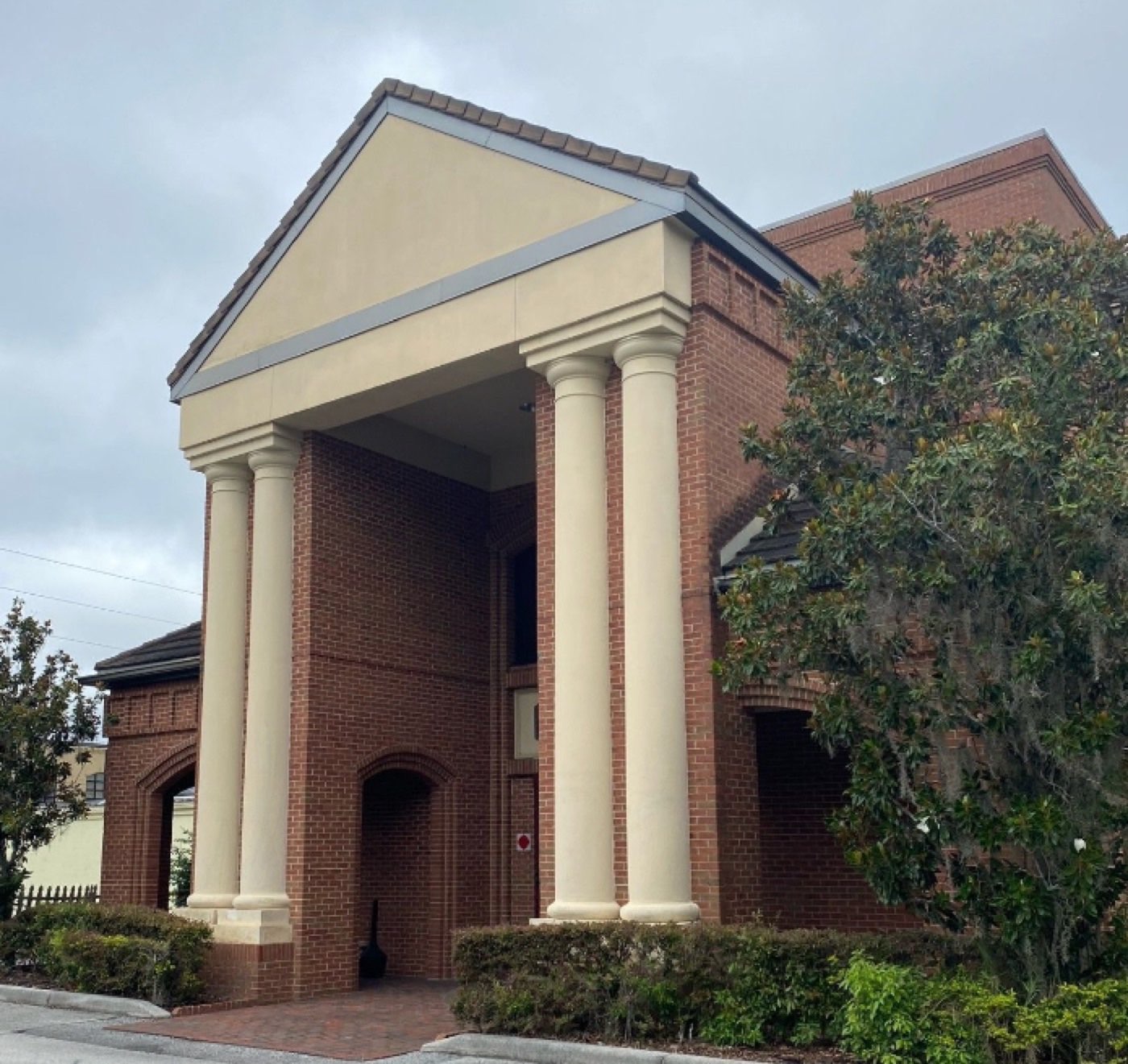
Senior primary care in Lakeland via Ascend Mind and Body: in-person at our downtown Polk County office (832 South Florida Ave, Suite 1, Floor 2, 33801) or via Florida telehealth follow-ups for established patients. Comprehensive primary care for adults 65 and over, including the Medicare Annual Wellness Visit, medication reconciliation, fall risk assessment, cognitive screening, chronic disease management, and advance care planning. Dr. Jason Saylor, DO is the physician. Call (863) 510-2624 or book online.
An office on South Florida Avenue, not a satellite
Polk County's older population has grown faster than its clinical infrastructure, and Lakeland seniors feel it as fifteen-minute appointments and a different face at every visit. Plenty of practices serve Lakeland from somewhere else. This one is here, on the Florida Avenue corridor a short walk from Lake Mirror, with surface parking nearby and an accessible building.
Location is not a small thing at this stage of life. A doctor's office you can reach in minutes gets used; one that requires a trip up I-4 gets postponed. Blood pressure follow-ups happen on schedule when the office is essentially on the way to everything else downtown. The practice being physically in Polk also means the plan we build accounts for where you actually live, which pharmacy you use, and which local specialists you already see.
Downtown rewards that proximity. The office sits on the stretch of Florida Avenue where Lakeland keeps its civic life, minutes from Munn Park and the Lake Mirror promenade, so an appointment folds into an ordinary morning instead of consuming one. Patients walk out of a visit and straight into their actual errands. It is a small dignity, and good geriatric care is largely the accumulation of small dignities.
Why continuity compounds in geriatric care
A 45-year-old can see a different urgent care clinician every year and lose little. After 65, that approach starts costing you, because so much of geriatric medicine is comparison. Is the memory complaint new or stable? Has the walk changed since last winter? Is this creatinine a blip or a slope? Those questions only have answers when one physician holds the thread.
Dr. Saylor holds it personally. He is the only physician you will see here, visit after visit, which turns the chart from a stack of disconnected encounters into a running story. Problems get caught while they are still small precisely because the person looking remembers what normal looked like for you.
There is a clinical multiplier hiding in the arrangement. Every year with the same physician makes the next year's care slightly better: baselines get richer, screening trends get longer, and the threshold for catching something early keeps dropping. Fragmented care resets that clock at every handoff. Continuity is not a comfort feature. It is compounding clinical information.
Your first sixty minutes
The first appointment runs about 60 minutes, and a first visit for a 72-year-old should feel nothing like a 22-year-old's sports physical. We collect a complete history, perform a focused examination, and reconcile the entire medication list. We run the screening set that belongs in senior care: cognitive screen, depression screen, fall risk assessment, vital signs, and a review of your preventive screening status.
You leave with an explicit plan: which labs are being drawn, which specialist follow-ups matter, which screenings are due this year, and what we are watching between now and the next visit. Follow-up appointments run 30 to 45 minutes. Five-minute medicine is not practiced here at any visit.
Come prepared with three things: your insurance information, every medication in the house, and the name of each clinician currently involved in your care. A family member is welcome in the room as well; a second set of ears helps at any age and costs nothing.
The annual wellness visit and the focused exam, together
An annual wellness visit is a structured yearly risk assessment: health risk questionnaire, medication review, cognitive screen, depression screen, fall risk check, vitals, and a preventive screening review. It is not the same thing as a traditional physical, and treating the two as interchangeable shortchanges patients. Our approach is to layer them, doing the wellness assessment and a focused exam in the same appointment so nothing falls between the two formats.
If you have Medicare, note that we do not bill Medicare directly for primary care, so we confirm your coverage and costs before your visit. Nobody should discover their financial arrangement from a statement after the fact, so we settle it on the phone first, plainly.
Patients sometimes arrive convinced the wellness visit is a bureaucratic ritual. Done properly it is the opposite: a once-a-year forcing function that ensures the screenings, the medication audit, and the prevention review actually occur instead of drifting from one "next time" to another.
The deprescribing conversation Polk seniors rarely get
A pattern we see across Lakeland, Mulberry, and Winter Haven: a dozen prescriptions written by four different prescribers, with overlaps and interactions that no one is tracking centrally. Each prescription made sense to someone at some point. The combination is what nobody has examined.
So bring all of it to the first visit. Every prescription bottle, every supplement, the over-the-counter sleep aid, the eye drops, the medication your spouse picked up that you are fairly sure is yours. We inventory the lot, check it against the American Geriatrics Society's 2023 updated Beers Criteria for potentially inappropriate medication use in older adults (J Am Geriatr Soc, 2023;71(7):2052-2081), and identify candidates for reduction. Then we do the unglamorous part: calling your specialists, agreeing on tapers, and following through. Deprescribing done well is slow and cooperative, and sometimes the honest conclusion is that the current list is correct. Either way, the review itself is the service.
What a cognitive screen tells you, and what it cannot
Families often arrive with a quiet worry about memory and no framework for it. The cognitive screen provides one. It is a brief, standardized set of thinking and memory tasks that establishes a baseline at your first visit and gets repeated over time, so change becomes measurable instead of anecdotal.
Two boundaries keep the tool honest. First, a screen is not a diagnosis; a low score is a reason to investigate, and the investigation sometimes finds reversible contributors such as medication effects, thyroid problems, depression, or poor sleep. Second, a normal score today does not promise anything about the future, and we will never pretend otherwise. When results and trajectory warrant it, we refer to neurology and coordinate that workup rather than leaving you to arrange it alone.
What families get out of this is a plan instead of a fog. Whatever the screen shows, you leave knowing what it means, what we are checking next, and when we will look again. Uncertainty with a schedule attached is far easier to live with than uncertainty alone.
Falls, treated as a medical problem with causes
A fall in your seventies is not bad luck; it usually has contributing causes that can be found and modified. Our fall prevention work is concrete: gait and balance evaluation in the office, a structured home safety review, orthostatic blood pressure checks, and a deliberate hunt through the medication list for drugs that impair balance or drop pressure on standing. Where a sedating medication can be reduced, that reduction often does more for fall risk than any grab bar. We track this at every visit, not once.
Polk's housing stock adds its own variables: ranch homes with a step-down garage, older bathrooms, terrazzo floors that turn slick. The home safety review walks through these specifics one by one, and the fixes are usually simple and fast once someone names them.
Conditions we manage year over year
- High blood pressure, monitored seated and standing given its link to falls
- Cholesterol management, with statin risk-benefit discussed for your age rather than by protocol reflex
- Type 2 diabetes, using HbA1c targets that shift for older adults and guarding against hypoglycemia
- Thyroid disease, common in seniors and easy to miss
- Chronic pain, managed through non-opioid approaches and deprescription where appropriate
- Preventive screening: cancer screening pacing, bone density, and immunizations including shingles, pneumococcal, RSV, COVID, and flu
- Cognitive change, from baseline screening through neurology referral when indicated
- Fall prevention as a standing agenda item
- Polypharmacy review and coordination across prescribers
- Advance care planning: living wills, healthcare surrogate designation, goals-of-care conversations held before they become urgent
Insurance and Medicare at the Lakeland office
The financial conversation belongs at the beginning, not buried in a statement six weeks later, so here it is in full. Dr. Saylor is currently in-network with Aetna, ChampVA, and UnitedHealthcare. We do not bill Medicare directly for primary care. Benefits are checked ahead of your first appointment, and if you carry Medicare or Medicaid, our care team will walk through what your options look like here before you commit to anything. No surprises is a clinical value too; a patient who trusts the billing tends to keep the follow-ups.
Self-pay rates depend on visit complexity and any labs, so a care coordinator confirms exact figures in advance. Our medical billing team answers those questions at (813) 670-3331.
None of it varies by payer. The visit length, the screening set, and the physician are identical whether a commercial plan is involved or you pay directly, because the clinical model is the product and it does not get renegotiated contract by contract.
Drive times from around Polk County
From central Lakeland, the South Florida Avenue office is about a 5-minute drive. Mulberry and Bartow reach us in roughly 15 minutes via 98 South. Plant City is about 20 minutes on I-4, and for many Plant City residents this office is simply closer than anything in Tampa. Auburndale and Winter Haven come in around 20 minutes via 540. Our Polk County service area includes Lakeland (33801, 33803, 33805, 33809, 33810, 33811, 33812, 33813), Mulberry (33860), Bartow (33830), Auburndale (33823), Winter Haven (33880, 33881, 33884), Plant City (33563, 33566), and Polk City (33868).
If you are weighing the drive against a satellite clinic somewhere nearer, weigh the right variable: not minutes to a parking lot, but minutes to a physician who will still be your physician next year. Measured that way, the Florida Avenue office holds up from anywhere in the county.
Telehealth once you are established
The initial visit and the annual wellness assessment are usually best done in the office, where an exam is possible. After that, established patients often move their routine chronic care to secure video: quarterly diabetes or blood pressure follow-ups from home, with lab work done locally beforehand. Dr. Saylor's Florida license covers telehealth statewide, so the option travels with you, whether you winter elsewhere in Florida or simply prefer to skip the midsummer parking lot. The in-person door on South Florida Avenue stays open either way.
Telehealth also earns its keep in ordinary friction: a summer downpour over the Polk Parkway, a car in the shop, a caregiver who cannot leave work that afternoon. The follow-up happens anyway, and chronic disease management is mostly the discipline of follow-ups that happen anyway.
Also see our nearby senior care options
- Senior care in Tampa: Hillsborough County office (Carrollwood)
- Senior care in Plant City: telehealth or short drive west to Lakeland
- Senior care in Brandon: Florida telehealth for the Brandon corridor
- Senior care pillar: full program detail, FAQs, and clinical scope
- Lakeland office: full office detail, all services
- Talk therapy: depression, grief, life transitions in later adulthood
FAQs about senior care in Lakeland
Where in Lakeland is the senior primary care office?
832 South Florida Avenue, Suite 1, Floor 2, in 33801. Downtown Lakeland just south of Lake Mirror. Most senior visits run 45 to 60 minutes for the Annual Wellness Visit, 30 to 45 for follow-ups.
Do you accept Medicare?
We do not bill Medicare. We are in-network with Aetna, ChampVA, and UnitedHealthcare, and we verify your benefits before your first visit and discuss self-pay options if needed. If you have Medicare or Medicaid, reach out to our care team and we'll walk you through your options.
What is the Medicare Annual Wellness Visit?
It's an annual preventive visit for Medicare beneficiaries that includes a health risk assessment, medication review, cognitive screening, fall risk assessment, depression screen, vital signs, and review of preventive screening status. It's not the same as a physical exam, but it is the foundation of geriatric primary care. We do a focused exam at this visit too.
Do you do home visits?
Currently no. Most senior care happens in office or via telehealth. For homebound patients, we'd refer to a home-based primary care service in your area.
How long is a senior primary care visit?
About 60 minutes for the first visit (or Annual Wellness Visit), 30 to 45 minutes for follow-ups. Telehealth visits typically run a bit shorter. We don't do five-minute appointments.
Can I do senior care via telehealth?
Yes, for follow-ups and chronic disease management. The initial visit and the Annual Wellness Visit are usually best done in person, but established patients often do quarterly chronic care follow-ups over secure video.
This page is informational and does not substitute for a clinical visit. Senior primary care decisions involve individual factors not captured in general content. Coverage of services depends on your specific Medicare or insurance plan.