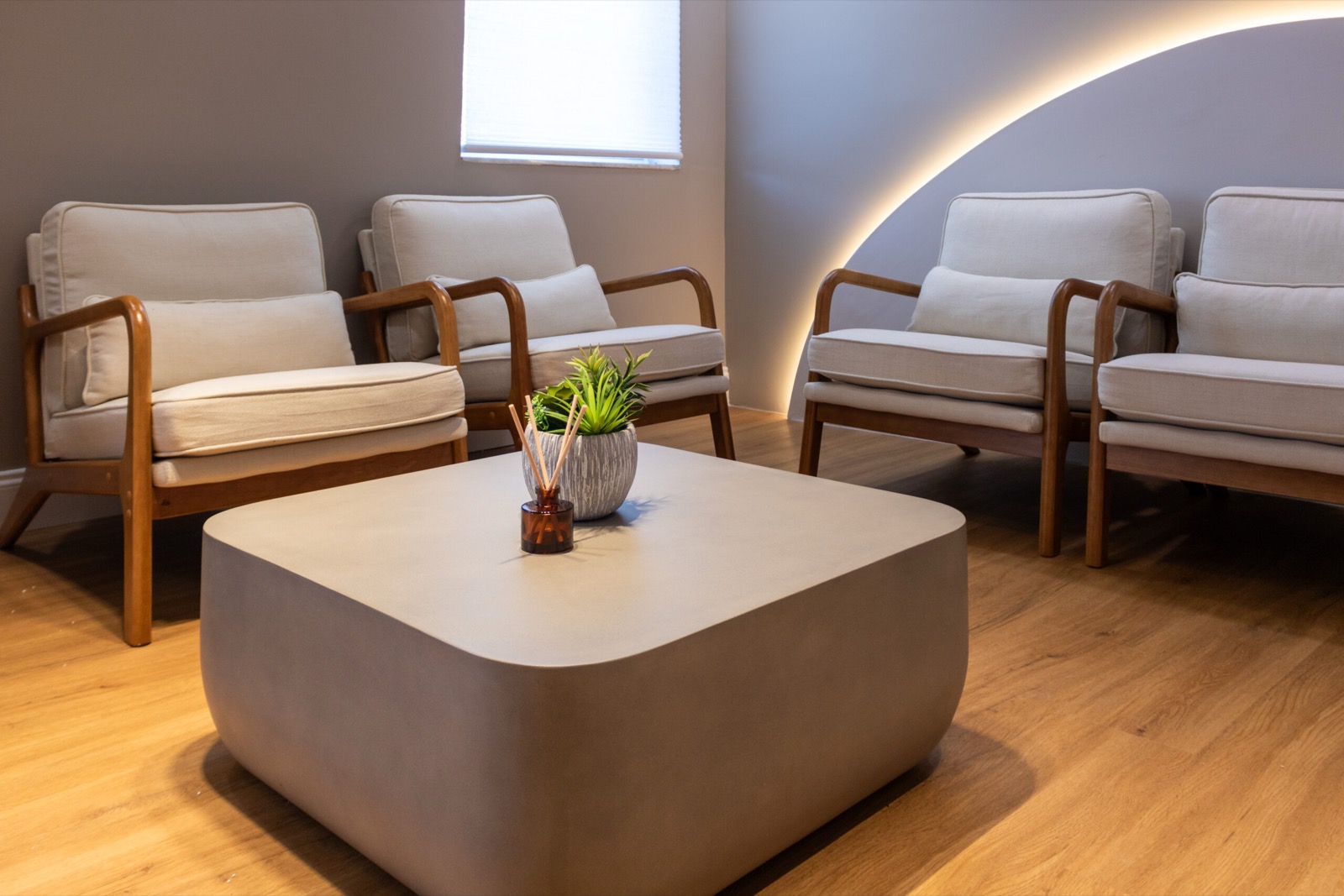
Wesley Chapel stays your home base
This distinction matters because cannabis certification works best when it isn't orphaned from the rest of your medical care. Wesley Chapel has no shortage of the other kind of option. The stretch of SR-54 through town, and the strip malls along Bruce B. Downs, cycle through certification storefronts that exist for exactly one transaction and know nothing else about you. Walk out of one of those and your primary care physician may never learn you were certified at all, which is a genuine problem the first time a drug interaction question comes up.
Certifying through Ascend keeps everything in one system. The physicians who manage your blood pressure, your mental health care, or your chronic pain at Cashford Circle share records with the physician making the registry decision. When PTSD is the qualifying condition, our psychiatry and talk therapy teams are the same hallway conversation, not a fax number. And after the initial evaluation, the ongoing rhythm of the certification, renewals, medication questions, coordination with your other treatment, flows back through the practice you already use. The card becomes one line in your medical story instead of a loose thread.
That integration is the entire reason to bother with a practice like ours. Wesley Chapel built itself around conveniences, the outlet mall at the interstate, the shops at Wiregrass, everything reachable in one loop of errands, and a five-minute certification fits that instinct neatly. But medicine keeps proving that the convenient version and the good version aren't always the same purchase. The patients who do best with cannabis certification tend to be the ones whose physician knew them before the card and keeps knowing them after it.
One certification visit happens in Carrollwood, and here's the honest why
Florida law does not allow a first-time certification by video. The initial Compassionate Use Registry evaluation must happen in person with the qualifying physician, and for Ascend patients that physician is Dr. Saylor, who performs these evaluations at our Tampa-Carrollwood office at 3971 Moran Road, Suite 101, Tampa, FL 33618. For Wesley Chapel patients that means about 30 minutes via SR-54 and North Dale Mabry Highway, once.
We'd rather tell you that plainly than pretend the visit happens somewhere it doesn't. The structure is one roughly 30-minute trip for the certification, then telehealth for what follows. Renewal evaluations, required at the state's current 210-day interval, can usually be done by video as long as you're physically in Florida during the appointment, so the ongoing burden of maintaining a card is measured in screen time, not windshield time. If Wesley Chapel is where you live and where your care lives, that's the shape of it: Carrollwood sees you once, and your home base keeps you.
Why not simply do everything at Cashford Circle? Fair question. Florida ties the certification to the qualifying physician personally, in the room, so the evaluation happens where Dr. Saylor currently performs these visits, and right now that's the Carrollwood office. If that arrangement changes, this page will change with it. Until then we'd rather describe the trip accurately than quietly imply a shorter one, which is precisely the kind of small dishonesty this corner of medicine has too much of already.
Inside the certification appointment
The evaluation runs 30 to 45 minutes, which tells you most of what you need to know about how it differs from a storefront visit. Dr. Saylor is a board-certified osteopathic family medicine physician with 17 years of experience and serves as Ascend's Chief Medical Officer. His day job is chronic disease management, and he approaches certification as a chronic disease decision: full medication list, treatment history, what's been tried, what worked, what didn't, and what the records actually document.
Those records are the backbone of the visit. Specialist notes, imaging reports, prior medication trials, psychiatric evaluations where PTSD is involved. Come with them if you can; we can help you request them if you can't. When the documentation and the clinical picture support certification, the recommendation is entered into the Compassionate Use Registry at that same appointment. When they don't, you'll hear that directly, along with what's missing and what we'd suggest instead, whether that's a workup for an undiagnosed pain source, a formal psychiatric evaluation, or a treatment path that doesn't involve cannabis at all. A real evaluation has more than one possible ending, and the visits that end without a certification are often the ones that mattered most, because they caught the question underneath the question.
Florida's rules, without the storefront gloss
Everything runs through Section 381.986 of the Florida Statutes. Registered qualifying physicians recommend; the Office of Medical Marijuana Use administers; you apply to the state for the patient ID card and pay the OMMU's application fee directly, separate from anything you pay us. Processing typically takes a few weeks, and the card then works at any licensed Medical Marijuana Treatment Center in Florida, including the dispensary locations that have opened around the SR-54 and SR-56 corridors. We hold no stake in any of them and steer you toward none of them. No physician can prescribe cannabis, here or anywhere in the United States, because it remains a Schedule I controlled substance federally. A registry recommendation is the entire legal mechanism, and it's worth being suspicious of any operation that talks about it like a prescription pad.
The statute's qualifying conditions, as of this writing: cancer, epilepsy, glaucoma, HIV/AIDS, PTSD, ALS, Crohn's disease, Parkinson's disease, multiple sclerosis, terminal conditions diagnosed by a second physician, chronic nonmalignant pain caused by or originating from a qualifying condition, and conditions of the same kind or class as those listed. Three cautions from practice. PTSD must be formally diagnosed, not self-identified. Chronic pain must trace to a qualifying condition, which is a documentation question as much as a medical one. And "same kind or class" is a conservative clinical judgment, not the loophole some advertising implies. The list itself can change with the legislature, so eligibility gets confirmed against current statute at your visit.
Where cannabis has evidence, and where it runs out
We hold cannabis to the same evidentiary standard as anything else we might recommend, and that standard produces a mixed report card. The 2017 National Academies consensus review found substantial evidence for benefit in adult chronic pain and chemotherapy-induced nausea and vomiting, moderate evidence for MS-related spasticity, and limited or insufficient evidence for much of the rest of what gets advertised. The PTSD data remains contested territory, which we discuss candidly with every PTSD patient who asks.
On the regulatory side, the FDA has not approved cannabis as a treatment for any condition. The lone FDA-approved cannabis-derived prescription product is a purified CBD medication for certain rare seizure disorders, and it is not what dispensaries sell. Cannabis is also never our opening move; standard treatments come first, and certification enters the picture alongside or after them when it's clinically reasonable. Side effects exist, drug interactions exist, individual responses scatter widely, and no honest clinic can guarantee approval or benefit. What we can promise is an accurate account of the evidence before you spend anything.
The card's legal weight, both directions
State law gives the card its protections; federal law and private policies set its limits, and you should know both before certifying. A Florida card provides no defense against a DUI charge, and driving while impaired by cannabis remains illegal in every circumstance. Federal firearm law prohibits controlled-substance users from buying or possessing guns, the purchase paperwork asks about marijuana in plain language, and a state medical card changes none of that. Employers retain the right to enforce drug-free workplace policies, which safety-sensitive and federally connected workplaces routinely do, and questions can surface in housing and custody contexts too.
We raise these tradeoffs at the evaluation, before the registry entry, because informed consent means the inconvenient parts get said out loud. Certification is available to adults 18 and older. This page is informational and isn't legal advice.
Billing, stated the way medicine should state it
Two fees, two recipients, no bundled teaser price. The clinical evaluation fee varies by visit type, and our billing team will confirm it when you call (813) 670-3331. The state ID-card application fee is paid directly to the OMMU and never appears on our invoice. Insurance nearly always declines to cover certification visits because of the federal Schedule I status, so plan for the evaluation to be self-pay. Where insurance can sometimes participate is in the underlying condition, the pain management, the psychiatric care, the chronic disease visits, billed as the ordinary medicine they are, separately from the certification. For Wesley Chapel patients already receiving that care at Cashford Circle, this often isn't a new bill at all; it's the care you were getting anyway, now coordinated with the certification decision.
A note on HSA and FSA money: plan rules differ, and many administrators specifically exclude cannabis-related expenses because of the federal classification. Ask yours before assuming those funds will apply.
The 33543, 33544, and 33545 readership
The Wesley Chapel ZIP codes, 33543, 33544, and 33545, make up the core of this page's readership, but the same arrangement serves the wider ring around town: Tampa Palms and New Tampa across the Hillsborough line, Land O' Lakes to the west, Lutz down the corridor, and Zephyrhills to the east. Each of those communities sits within reach of the same one-visit structure, and several have their own pages with routes drawn from their side of the map.
Two practical suggestions before you book. First, call (813) 670-3331 rather than guessing at anything this page left open; the coordinators handle these questions all day. Second, if you're already an Ascend patient at Cashford Circle, say so when you schedule. Your records are on hand, which shortens the paperwork and lets the certification visit start from what your care team already knows instead of from a blank intake form.
What integrated actually means, in practice
Integration is a word every practice claims, so it is worth saying what it concretely changes for a Wesley Chapel patient. It means the physician deciding on a registry entry can open the same chart your primary care doctor has been writing in. It means a PTSD diagnosis does not have to be re-established from a faxed summary, because the clinician who made it works for the same practice. It means a medication interaction is caught by someone who can see the entire list, not the portion you remembered to mention.
The counterexample is the ordinary one. A patient certified at a storefront has a card that exists nowhere in their medical record, and the first person to discover this is usually a physician making a decision that would have been different with the information. That is not a hypothetical failure mode; it is the normal outcome of separating one medical decision from all the others.
None of this requires you to be an existing patient. It does explain why the arrangement is worth more to someone who already is.
Two clocks to keep track of
Certification runs on the state's evaluation interval, currently 210 days, and the patient ID card runs on whatever period current state rule sets for the card. They are separate, they are administered by different parties, and letting one lapse while watching the other is a common and avoidable annoyance.
Inside the practice, the clinical one is tracked for you and the reminder comes before the deadline rather than after it. The state card remains your application to file and your fee to pay directly to the Office of Medical Marijuana Use; nobody can do that half on your behalf. Knowing which is which ahead of time is most of what keeps the maintenance uneventful.
Care that connects to this decision
- The Wesley Chapel campus: your home base at Cashford Circle
- The medical marijuana program: the full program detail
- Psychiatry: where a PTSD qualifying diagnosis is established
- Talk therapy: care that often runs alongside certification
- Land O' Lakes certification: with more on the renewal cycle
- Lutz certification: with a step-by-step walk through the visit
FAQs about medical marijuana evaluation in Wesley Chapel
What are Florida's qualifying conditions?
Florida law lists specific qualifying conditions, including cancer, epilepsy, glaucoma, HIV/AIDS, PTSD, ALS, Crohn's disease, Parkinson's disease, multiple sclerosis, medical conditions of the same kind or class, terminal conditions, and chronic nonmalignant pain caused by or originating from a qualifying medical condition. The list can change as state law evolves; we confirm eligibility at your evaluation based on current statute.
Where is the Wesley Chapel evaluation done?
The initial Compassionate Use Registry evaluation is done in-person per Florida law at our Tampa-Carrollwood office (3971 Moran Road, Suite 101, Tampa, FL 33618), about 30 minutes from Wesley Chapel via SR-54 and North Dale Mabry Highway. Follow-up visits can often be done via telehealth.
I already see an Ascend provider at Cashford Circle. Does that change anything?
It makes the visit shorter and better informed. Your records are already in the system, so the evaluation starts from a documented history rather than a blank intake form, and the physician making the registry decision can see what your care team has actually been treating. Say you are an existing patient when you schedule.
Will my Ascend care team see the certification in my chart?
Yes, and that is most of the argument for certifying inside the practice that already treats you. The certification is not filed somewhere separate; it sits in the same record your primary care physician and, where relevant, your psychiatric clinician are working from. Nobody has to be told about it later because nobody was left out of it.
Can my psychiatrist and the certifying physician coordinate?
They can, and for a PTSD-based certification they generally should. A registry decision resting on a psychiatric diagnosis is better made with the clinician who established that diagnosis in the loop, and inside one practice that coordination is a conversation rather than a records request.
Do I need a referral from my Ascend primary care doctor?
No. You can book a certification evaluation directly, whether or not you are an existing patient. Your own physician's input is useful and often shortens the visit, but it is not a gate you have to pass through first.
Will certification change my other prescriptions?
It might prompt a conversation about them. Cannabis interacts with sedatives, certain psychiatric medications, seizure medications, and anticoagulation, so the full list gets reviewed and anything concerning gets raised with you and, inside the practice, with the clinician prescribing it. Nothing gets changed quietly.
Can follow-ups happen at Cashford Circle instead of by video?
Renewal evaluations are usually handled by telehealth, which most patients prefer once they have made the initial drive. If you would rather be seen in person, raise it with the coordinators when you schedule so they can tell you what is currently available. Call (813) 670-3331 and ask directly rather than assuming from this page.
Sources
- Florida Statute § 381.986 (medical use of marijuana)
- Florida Office of Medical Marijuana Use (OMMU), patient registry and ID card guidance; Chapter 64-4, F.A.C.
- National Academies of Sciences, Engineering, and Medicine (2017). The Health Effects of Cannabis and Cannabinoids.
- FDA: cannabis-derived drug approvals and cannabis regulatory status
- Federal firearm restrictions for controlled-substance users (18 U.S.C. § 922(g)(3))
Medical cannabis is regulated under Florida Statute §381.986 and is not approved by the FDA for the treatment of any condition. The clinical evidence varies substantially by condition. Side effects and drug interactions exist and are discussed during evaluation. Cannabis remains a federally controlled Schedule I substance. This page is informational and does not substitute for a clinical visit. See Fla. Stat. § 381.986 and the Florida Department of Health, Office of Medical Marijuana Use (Chapter 64-4, F.A.C.).